Traditional outsourcing creates a familiar pattern:
What we do
Exit by Design
Results of exit by design
Month 9
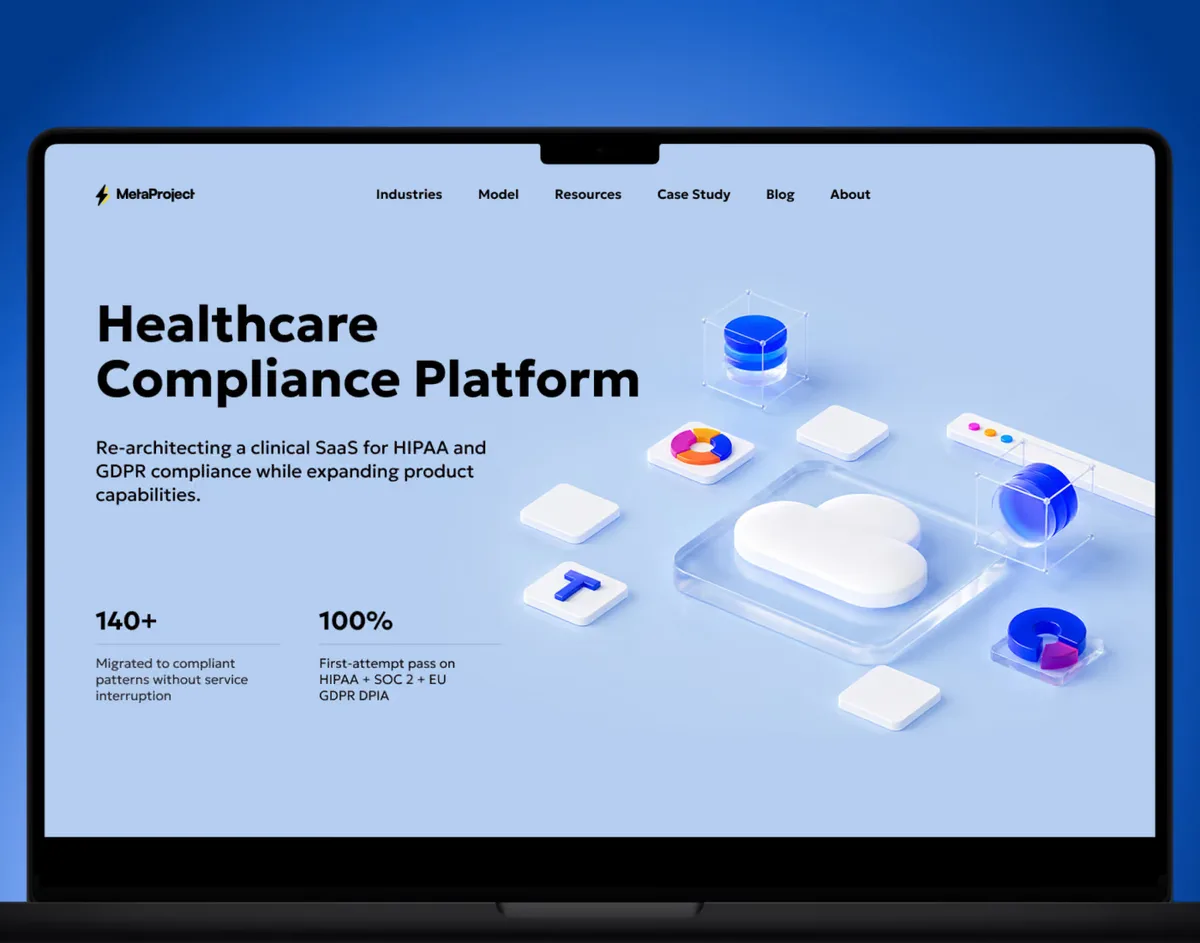
when the client team passed its next audits without us
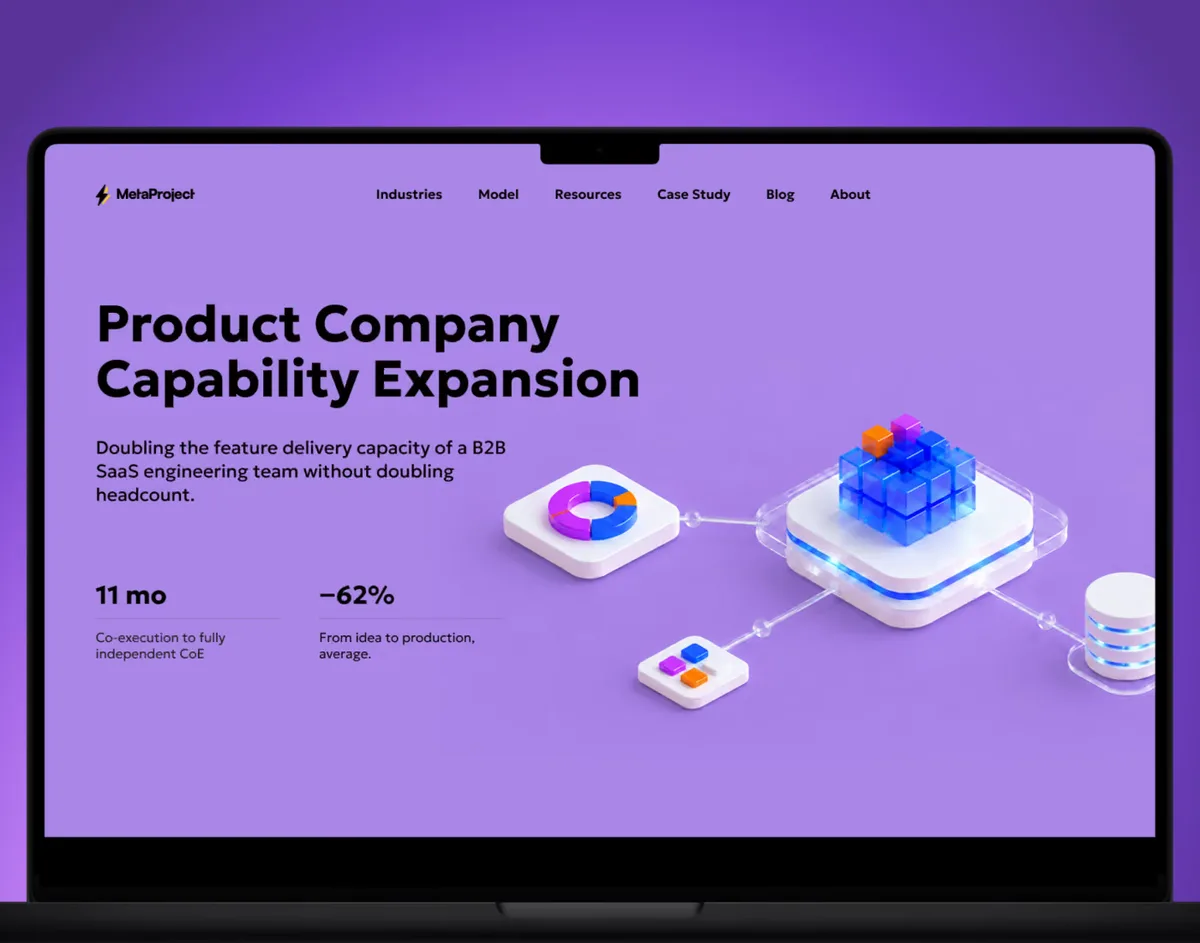
Clinical SaaS case11 mo
from co-execution to a fully independent CoE
B2B SaaS case−45%
annual spend on external consultants and contractors
B2B SaaS caseMost software development outsourcing looks efficient until you realise you’ve outsourced your ability to change. Vendors hand you code, keep the know-how and quietly become irreplaceable.
MetaProject is built differently. Exit by Design means every engagement is structured so our role decreases as your internal capability increases. That happens by plan, not by accident.
We still deliver the hard things you’d usually give to a software outsourcing company: legacy application modernization, application replatforming, cloud migration services, monolith to microservices migration, CI/CD pipeline implementation, SaaS application development, web and mobile app development. The difference is that we design our own exit into the work from day one.
MetaProject is built differently. Exit by Design means every engagement is structured so our role decreases as your internal capability increases. That happens by plan, not by accident.
We still deliver the hard things you’d usually give to a software outsourcing company: legacy application modernization, application replatforming, cloud migration services, monolith to microservices migration, CI/CD pipeline implementation, SaaS application development, web and mobile app development. The difference is that we design our own exit into the work from day one.
The outsourcing trap we’re avoiding
Every major feature or refactor depends on the vendor’s architects and seniors.
Code is handed over, but architecture decisions, domain trade-offs and delivery know-how stay outside.
Your internal team becomes “implementers around the edges” rather than owners.
Vendor costs increase with each new project; switching vendors looks risky and expensive.
For each stakeholder, that looks like:
CTO / CPO
You can’t easily change your product strategy, pricing model or platform without a negotiation with your vendor.
VP Engineering / Head of Engineering
You run teams, but don’t fully own the microservices architecture, CI/CD pipelines, or delivery model that drive them.
Product & Delivery leaders
Roadmap is limited by vendor bandwidth, not by what’s best for customers.
Engineering leads & ICs
There’s always “the vendor way” and “our way,” and the two keep diverging.
Procurement / Finance
Dependency and OPEX creep up over time; you’re effectively renting expertise indefinitely.
Exit by Design exists to flip that script.
Your path to autonomy: the transition roadmap
Every engagement follows a 3-phase transition roadmap, the same structure you show in the core deck and on the main site.
Phase 1
Co-Execution
We lead, your team shadows
Senior MetaProject squads take point on mission-critical work, for example:
A legacy application modernization and cloud migration of a revenue-critical platform.
A monolith to microservices migration for your B2B SaaS product.
Standing up CI/CD pipeline implementation, DevOps / DevSecOps practices and observability from scratch.
Phase 2
Transition
Codify & Coach
Ownership starts to tilt toward your side:
Your tech leads run stand-ups, design reviews and release rituals; our seniors act as sparring partners and safety net.
We intensify codification: CI/CD, testing strategy, incident response, domain models and governance are fully documented and handed over.
We keep delivering features (e.g. in your SaaS application development, web application development, mobile app development streams), but increasingly on your terms and inside your operating model.
Phase 3
Self-Sufficiency
Transfer & Exit
By this point:
You’re operating your own Center of Excellence (CoE) with clear standards for architecture, pipelines and delivery.
MetaProject shifts into an architectural counsel role (periodic reviews, complex design decisions, occasional accelerators) rather than ongoing dependency.
Success is explicitly measured in reduced vendor reliance, higher deployment frequency, and lower lead time, not in how long we can stay.
This is why the model is called Exit by Design, not by necessity.
Designing the exit from day zero
Exit by Design is not a “we’ll see at the end” conversation. It shows up in how we set up the engagement:
Explicit exit criteria
Capability and ownership milestones alongside feature lists.
(e.g. “team can operate CI/CD and release governance without external support”, “CoE runs its own architecture review forum”).
Scope framed as capability, not just output
Modernising a payments platform ← → and leaving you with domain models, compliance playbooks and automated audit pipelines.
Replatforming a SaaS monolith ← → and leaving you with microservices guidelines, SLOs and incident runbooks.
Shared roadmap to self-sufficiency
A transparent view of when MetaProject leads, when ownership flips, and when we expect to be largely out of day-to-day delivery.
Hiring & capability plan
Recommendations on team structure, senior hires, and skill mix needed to run the new architecture, platforms and delivery model internally.
Every sprint, your backlog moves forward and your internal playbook gets richer.
What each stakeholder gets from Exit by Design
CTO / CPO
A clear path from vendor-reliant to CoE-driven in 9–12 months, backed by concrete milestones and proof points.
Strategic control: architecture, standards and delivery model live inside your organisation.
VP Engineering / Head of Engineering
A structured handover of microservices architecture, CI/CD pipelines, observability, QA and DevSecOps into your team’s hands.
A hiring and capability roadmap that spells out how to staff and grow your CoE over time.
Product & Delivery leaders
Confidence that a major legacy migration, replatforming, SaaS rebuild or continuous delivery initiative won’t lock the roadmap to a single vendor.
Predictable release governance and clear ownership lines after the initial engagement.
Engineering leads & ICs
A shift from “we implement what the vendor decides” to “we own this system and the playbooks behind it.”
Embedded mentorship during real work, so they grow into ownership instead of inheriting a black box.
Procurement / Finance
A credible, observable dependency reduction story: for example, vendor reliance ↓ 40%, deployment frequency ↑ 3×, lead time ↓ 35%.
The ability to treat MetaProject as a strategic lever, not a permanent line item.
Where Exit by Design matters most
Exit by Design is critical when you’re considering outsourcing:
Legacy application modernization and legacy system migration
Application replatforming and cloud migration services
Monolith to microservices migration and architecture modernization
CI/CD pipeline implementation, DevOps / DevSecOps rollouts, observability and production readiness
SaaS application development, web application development, mobile app development that sit at the heart of your revenue or compliance story
In other words: the projects where a traditional software outsourcing model tends to produce the deepest dependency.
The pillar that makes the other pillars safe
Exit by Design is what makes the rest of the MetaProject model safe to adopt:
Delivery as Training
Seniors leading builds and mentoring your engineers.
Seniority as Strategy
Senior-only squads handling complex architecture, modernization and delivery work.
Knowledge Transfer Systems
ADRs, playbooks, runbooks, pipelines and handbooks that stay inside your organisation.
Together, they turn software development outsourcing into a capability engine, with a clear, designed path to independence rather than a quiet drift into lock-in.
Make the exit part of the plan
If you’re considering outsourcing high-stakes work, from legacy modernization or replatforming to CI/CD and DevSecOps or a full SaaS rebuild, this is the moment to design the exit, not after the contract ends.
We typically start with a Capability Blueprint Workshop: a focused engagement (4-ish weeks) that maps your architecture, delivery model, dependency risks and capability gaps, then outlines a transition roadmap to your own CoE and the self-sufficiency milestones that will define a successful exit.
We typically start with a Capability Blueprint Workshop: a focused engagement (4-ish weeks) that maps your architecture, delivery model, dependency risks and capability gaps, then outlines a transition roadmap to your own CoE and the self-sufficiency milestones that will define a successful exit.
Talk through your path to running it without us