We don’t treat documentation as a “phase” at the end. Docs-first workflows mean:
What we do
Knowledge Transfer Systems as Strategy
Results of knowledge transfer
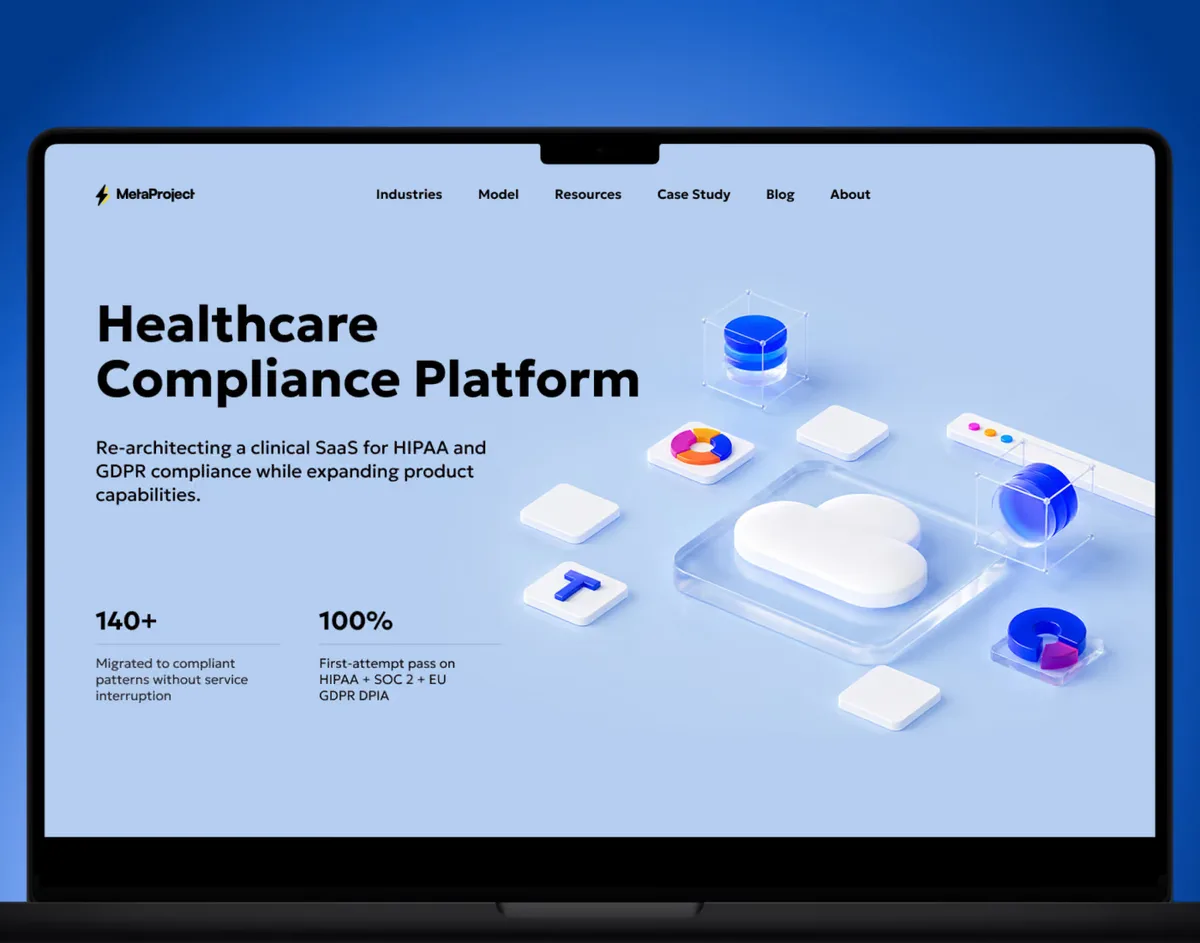
6 wks
to onboard a new engineer, down from six months
Clinical SaaS case+28pp
senior engineer retention, 18 months after the transition
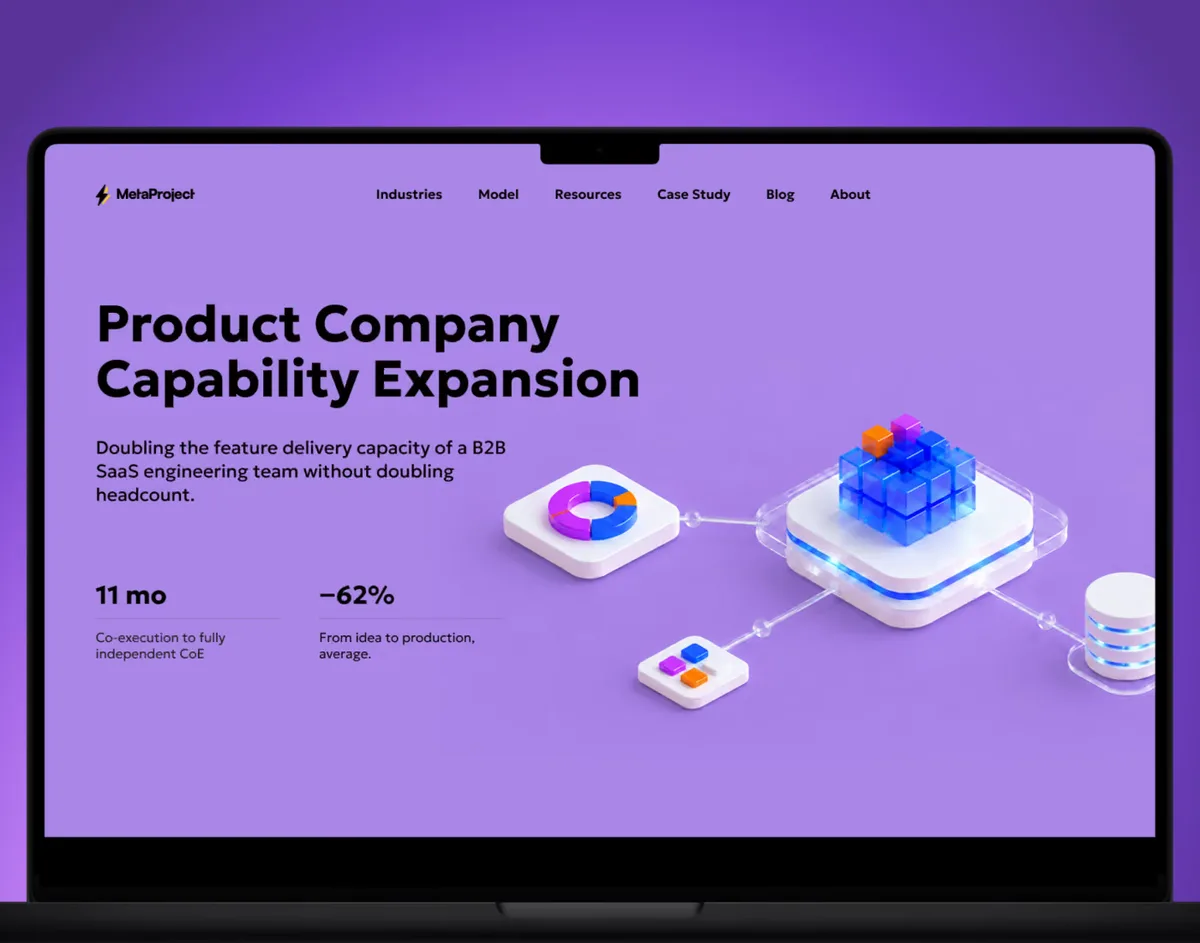
B2B SaaS caseMonth 9
when the client team passed its next audits without us
Clinical SaaS caseMost software outsourcing vendors hand you code and call that “delivery.”
MetaProject builds Knowledge Transfer Systems so you inherit the know-how along with the repo.
We embed alongside your teams to deliver critical work (legacy application modernization, application replatforming, CI/CD pipeline implementation, SaaS application development) while systematically transferring the architecture, domain knowledge and delivery discipline behind it.
The result is a finished project plus a working, documented operating system your own people can run and evolve.
MetaProject builds Knowledge Transfer Systems so you inherit the know-how along with the repo.
We embed alongside your teams to deliver critical work (legacy application modernization, application replatforming, CI/CD pipeline implementation, SaaS application development) while systematically transferring the architecture, domain knowledge and delivery discipline behind it.
The result is a finished project plus a working, documented operating system your own people can run and evolve.
The problem: code handover ≠ knowledge handover
Traditional outsourcing creates an IP gap:
Code arrives, but the reasoning behind it doesn’t.
Architecture and trade-offs live in a vendor’s heads and slide decks.
Every change becomes a negotiation, not a team decision.
For each stakeholder, that risk looks different:
CTO / CPO
Уou own a business-critical platform you can’t confidently change without calling the vendor.
VP Engineering / Head of Engineering
Onboarding is slow, the bus factor is scary, and standards vary by squad.
Product & Delivery leaders
Roadmap decisions are constrained by “what the vendor can do this quarter,” not what’s strategically right.
Engineering leads & ICs
Lots of tribal knowledge, few reliable references; “how things work” travels by word-of-mouth.
Procurement / Finance
Vendor lock-in drives OPEX up every year; you pay repeatedly for the same domain expertise.
MetaProject exists to close that IP gap. Our model is built so every sprint delivers capability as well as code.
What a Knowledge Transfer System is (for us)
At MetaProject, a Knowledge Transfer System is the combination of:
Artifacts
the things you can search and reuse
Runbooks, SLO/SLA definitions, incident guides
Architecture Decision Records (ADRs)
Domain models and decision trees
Engineering playbooks and internal handbooks
Pipelines & automation
knowledge baked into how software ships
CI/CD pipelines with embedded security and observability
Automated compliance checks and quality gates
Deployment pipeline design, rollback, and recovery paths
Docs-first workflows
how decisions are made and captured
Documentation-first approach to architecture, branching, and testing strategies
Architecture reviews and design sessions whose outcomes get written down and codified
Ways of working that make documentation part of the sprint, not an afterthought
Transition path
how ownership moves from MetaProject to your CoE
Co-execution → transition → self-sufficiency
Clear exit criteria defined up front, not when the project is already over
Taken together, this is the knowledge infrastructure that makes “build capability, not dependency” real.
The artifact stack: from ADRs to playbooks
We design each engagement so the knowledge you need is easy to find and actually used.
Architecture layer
Architecture Decision Records (ADRs) for all significant decisions, from microservices boundaries to data ownership to integration patterns.
Reference architecture diagrams for your microservices architecture design, legacy application modernization, cloud migration and replatforming work.
Delivery layer
CI/CD pipeline documentation: environments, branches, promotion paths, rollback strategy.
QA and testing strategy, including automated checks mapped to risk areas.
Runbooks and on-call guides: how to respond when things go wrong in production.
Domain & product layer
Domain models and decision trees that encode vertical expertise: fintech compliance, healthcare interoperability, logistics data flows, B2B SaaS tenancy, etc.
“What we won’t do and why”: constraints and trade-offs made explicit, so future teams don’t accidentally break them.
Team & onboarding layer
Internal engineering handbook sections for new hires: architecture overviews, coding standards, branch model, release process.
Skills matrix and capability expectations for key roles in your CoE.
The outcome: new engineers can join your custom software development, SaaS application development, or high-load backend initiatives and become productive faster, without needing the original vendor as a translator.
Docs-first delivery, not post-project documentation
Decisions and standards are documented in real time, as we design and build.
Architecture reviews, CI/CD changes and domain modelling sessions all end with artifacts (ADRs, diagrams, playbook updates) checked into your repos and wikis.
Our senior squads are measured on IP transfer and playbook maturity as well as feature throughput.
For your teams, that means less “ask Bob” and more “check the playbook,” especially in areas like CI/CD, DevSecOps, release governance and incident response.
How Knowledge Transfer Systems are built into every engagement
Knowledge Transfer Systems are not a separate workstream; they’re baked into how we deliver. We align this with your 3-phase path to autonomy:
Phase 1
Co-Execution
Embed & Capture
Senior squad leads delivery on high-stakes work: legacy system migration, monolith to microservices migration, CI/CD pipeline implementation, cloud migration services, SaaS development.
We start capturing ADRs, pipeline definitions, and domain decisions from day one.
We start capturing ADRs, pipeline definitions, and domain decisions from day one.
Phase 2
Codification
Codify & Coach
Your leads start running architecture reviews, stand-ups, and release rituals with us as a safety net.
We intensify playbook building and internal handbook creation; CI/CD, observability and testing strategies are fully documented and handed over.
We intensify playbook building and internal handbook creation; CI/CD, observability and testing strategies are fully documented and handed over.
Phase 3
Transition
Transfer & Exit
You operate your own Center of Excellence (CoE); we step back into architectural counsel only.
Knowledge Transfer Systems are now internal assets: your playbooks, your pipelines, your governance model.
Knowledge Transfer Systems are now internal assets: your playbooks, your pipelines, your governance model.
Every engagement starts with this exit by design in mind. Success is defined by how little you need us later, not how long we can stay.
What each stakeholder gains
CTO / CPO
Clear line of sight from architecture choices to business risk.
Confidence that critical systems (payments, clinical workflows, logistics, multi-tenant SaaS) can evolve without re-outsourcing.
VP Engineering / Head of Engineering
A consistent engineering handbook, ADR library and CI/CD playbooks instead of “whatever the last team did.”
Faster onboarding, lower bus factor, and fewer “heroic fixes” because knowledge is systematised.
Product & Delivery leaders
Transparent decision records; less time re-litigating old trade-offs.
A predictable software delivery operating model: clear release governance, QA strategy, and risk management.
Engineering leads & ICs
Practical, up-to-date references (runbooks, playbooks, domain models) they can rely on day-to-day.
Embedded mentorship during real work, instead of abstract training disconnected from the actual system.
Procurement / Finance
Documented knowledge and playbooks that stay in-house even if the vendor relationship changes.
Reduced vendor dependency and lower total cost of change over the lifecycle of the platform.
Is Seniority-as-Strategy right for this initiative?
This model is usually the right fit when you’re looking at work like:
Legacy application modernization and legacy system migration.
Application replatforming and cloud migration services.
Monolith to microservices migration and architecture modernization.
CI/CD pipeline implementation, DevSecOps and observability roll-outs.
SaaS application development, web application development, mobile app development that sit at the heart of your business.
These are precisely the projects where a traditional software outsourcing model creates deep dependency. Knowledge Transfer Systems flip that equation: you come out with more internal capability than you had when you started.
Turn outsourcing into a capability engine
Knowledge Transfer Systems are one of the four pillars of the MetaProject model, alongside Delivery as Training, Seniority as Strategy, and Exit by Design. Together, they turn software development outsourcing into a capability engine for your organisation, not a permanent crutch.
To see what this could look like for your platform, we start with a Capability Blueprint Workshop: a focused engagement that maps your architecture, delivery model, knowledge gaps, and capability priorities, and designs the Knowledge Transfer Systems your future CoE will rely on.
To see what this could look like for your platform, we start with a Capability Blueprint Workshop: a focused engagement that maps your architecture, delivery model, knowledge gaps, and capability priorities, and designs the Knowledge Transfer Systems your future CoE will rely on.
Talk through how knowledge moves inside your team