Navigating Market Challenges
Learn strategies for overcoming common market challenges faced by businesses.

Software Project Kickoff in Europe vs USA: Key Differences
When a new software project starts, the first week usually tells you everything you need to know about what the next 6–18 months will be like. Working with clients across Europe and the US, we keep seeing the same pattern: both sides want working software, predictable delivery, and clear ROI. But they define it very differently.
Both optimize for different things:
- US teams optimize for speed
- European teams optimize for risk reduction
When we start a new project, the first step is to understand what the client optimizes for in the opening phase: rapid market feedback or early risk control.
After more than 5 years and 50+ released projects, that single clarification has proven more useful than any generic methodology. It tells us how to shape discovery, how detailed the initial documentation should be, how we structure the first release, and which stakeholders must be involved from day one.
How Projects Start in the USA: Speed First
In the US, competition moves fast, so founders and product leaders feel constant pressure to validate ideas quickly and secure the next round by showing traction. The question they come with is: “How soon can we put something in front of users?”
Over the last few years, US-based startups have consistently attracted more than half of global venture funding. In 2025, around 64% of all startup capital went to US companies, which keeps local competition intense and timelines short.
Instead of spending months polishing a full release, teams want a pilot, prototype, or MVP they can show to customers. The primary success metric here is: how quickly can we get real market feedback?
That translates into a very specific week-one pattern:
- Fast discovery: short, focused sessions instead of long documentation cycles.
- Lots of customer calls: interviews, demos, and screen shares to test assumptions.
- A demo build as soon as possible: even if it’s rough, it should be real.
This approach works well in competitive markets where being three months late can mean losing the entire opportunity. Instead of funding a full solution upfront, US companies fund phases and double down only after early signals are positive.
From our experience, US projects usually mean compressed discovery and short cycles between the first demo and market test. We have built and released multiple MVPs for fintech and customer services clients, where the first usable version had to appear within a few sprints.
How Projects Start in Europe: De-Risk Before Delivery
In Europe, especially in fintech, healthcare, and B2G, founders are more focused on GDPR, sector regulation, public procurement rules, and operational risk. Here, the question is usually: “How do we make sure this project is compliant and controlled before we commit serious budget?”
Stakeholders want to know:
- Do we understand the problem and business process well enough?
- Are there regulatory or compliance blockers?
- Can we define scope boundaries clearly so the project does not drift?
As a result, the opening pattern looks different:
- Stronger upfront discovery: workshops, process mapping, stakeholder interviews.
- Earlier attention to privacy, security, and data flows, not as an afterthought.
- Clearer documentation of scope, constraints, and acceptance criteria before development starts.
What Decision-Makers Should Standardize in Any Region
Industry research regularly shows that a large share of software projects overrun budget, miss deadlines, or fail to deliver expected value due to unclear goals or poor communication between business and delivery teams. Surveys across industries show that around a third of projects fail to meet their original business objectives, even when they technically deliver scope.
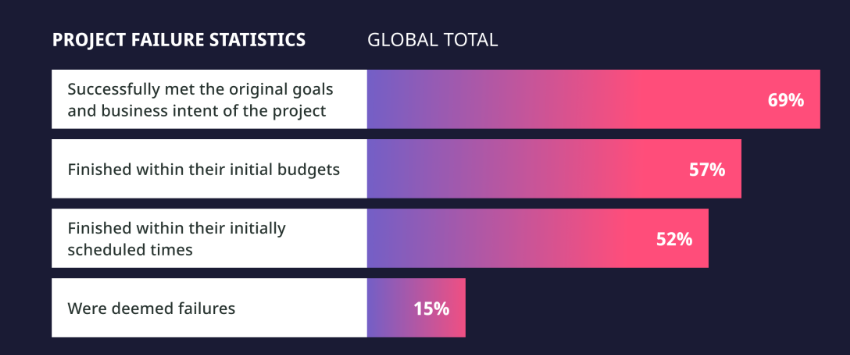
Source: https://proceve.com/the-cost-of-project-failure/
So, no matter where a project starts, the structural elements of a good start are the same. So if you’re on the decision-making side, there are a few things worth standardizing, regardless of region or sector.
1. Clear Business Objectives
Before you talk about tech stack or sprint cadence, you need a concise answer to a simple point: what business outcome should this product change in the next 6–12 months?
That can be:
- Reduced processing time for a core operation
- Higher conversion in a key funnel
- Lower operational cost for a specific workflow
- Better data quality for a particular reporting
At Meta Project, every new engagement is tied to explicit business metrics, even if they are initially directional. That gives product, engineering, and stakeholders a shared reference for trade-offs.
2. Defined Ownership and Decision Structure
Projects break because no one is clearly accountable for decisions. At the start, there should be:
- A named product owner or business sponsor with decision-making power
- A clear list of stakeholders (operations, legal, compliance, IT, commercial)
- An agreed path for approvals and escalations
This is especially critical in B2G, finance, and healthcare, where the number of stakeholders is high, and decisions often cross departments.
3. Agreed Discovery Format
Whether the project leans towards a quick MVP or a deeper upfront analysis, discovery is not optional. What should be defined early:
- How many workshops and with whom
- What artefacts will be produced (user journeys, system context diagrams, backlog outline, risk list)
- When discovery is considered “good enough” to move into build
It also gives the delivery partner a clear framework to structure work in the first 2–4 weeks.
4. Shared View on Constraints
Every project operates under constraints: regulatory, technical, operational, or budget-related. At minimum, this includes:
- Regulatory and compliance boundaries (GDPR, HIPAA, PSD2, public procurement, internal security policies)
- Integration requirements and legacy dependencies
- Timeline anchors (external commitments, go-live windows, funding milestones)
When these are formalized early, both “speed to learning” and “risk reduction” become realistic, because the team knows where they can experiment and where they cannot.
5. Transparent Communication Model
Communication needs structure just as much as code or architecture. From day one, set:
- Meeting schedule: updates, product reviews, technical syncs
- Reporting format: what is reported, how often
- Escalation rules: what happens when scope, budget, or timeline drift
When these five elements are standardized, regional differences become a matter of style. We use the same structural backbone for every engagement, then adjust the depth of analysis and speed of delivery to the client’s context.
Conclusion
Both models aim at the same thing: a product that works, delivers value, and does not put the business at unnecessary risk. Neither approach is better by default. Each reflects its market context, budget logic, and risk appetite.
At Meta Project, we tailor the starting phase to business needs so teams can move with clarity from day one. Our team includes 30+ specialists, and clients consistently highlight our work quality, awarding us a 5.0 rating on Clutch.
CTA: If you’re planning a new project, book a call with us – we’ll help you choose the right discovery depth and map a realistic starting plan.
Recent blog posts
Learn strategies for overcoming common market challenges faced by businesses.