Half the planning time, with the orthodontist in charge
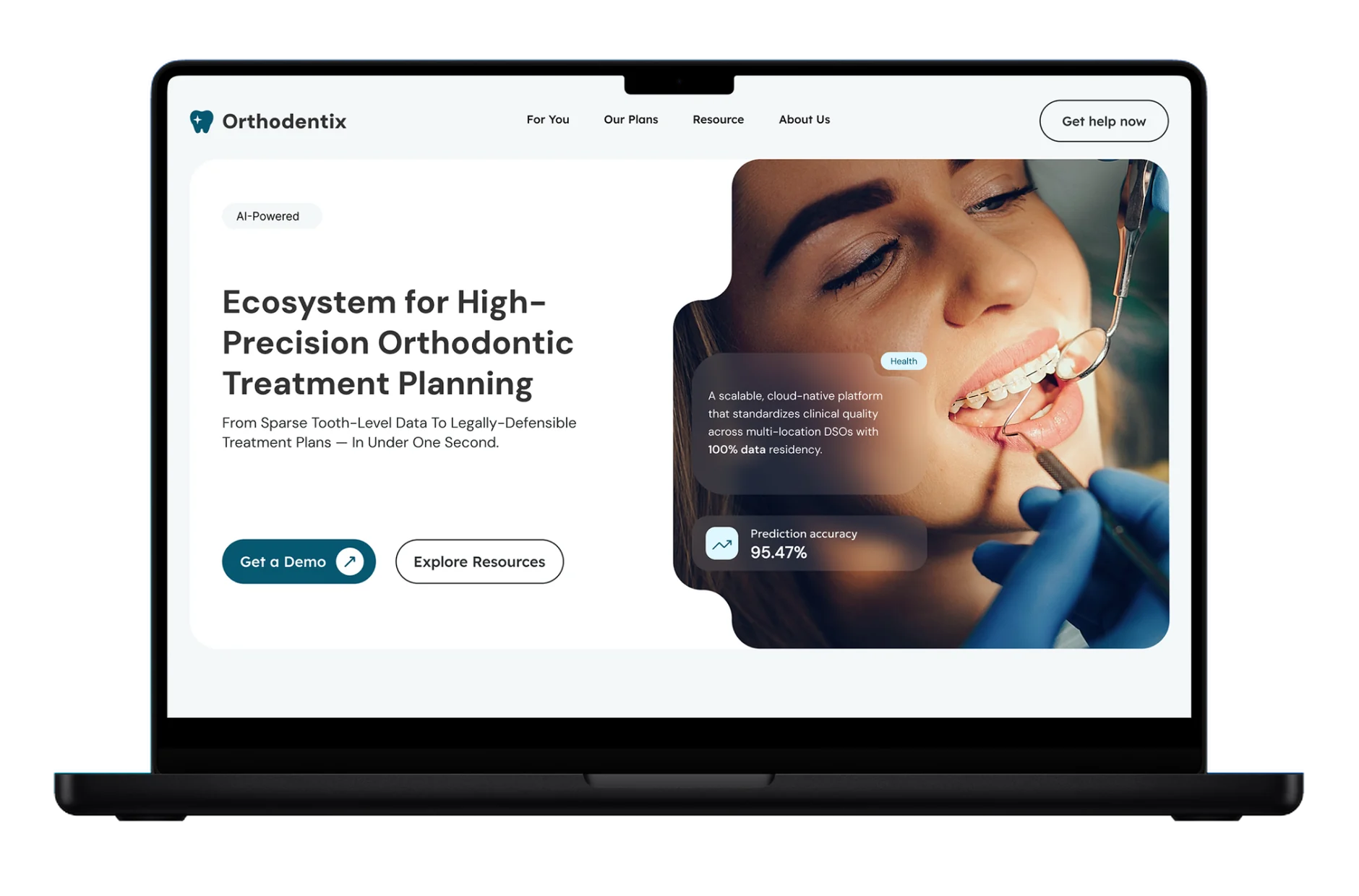
Orthodontists at European dental groups spent hours drafting the formal reports around every treatment plan. We built an ML and LLM platform that drafts and checks those plans, with all patient data kept in HDS-certified European hosting.

Clinics were capped by paperwork, not by clinical skill
European orthodontic clinics lose hundreds of hours a year to manual analysis and to drafting formal clinical reports. Every treatment plan has to satisfy clinical and legal standards, so the documentation around it grows with every patient. That load, more than the quality of care, set the limit on how many patients a practice could take.
Rushed manual entry also created risk. European clinical communication is held to a formal doctor-to-doctor standard, and imprecise phrasing weakens a clinician's authority and contributes to serious medical errors. Manual workflows also struggled to produce the audit trail that GDPR and HDS certification require.
The brief: take the documentation load off clinicians across multi-location dental service organisations, keep every patient record inside HDS-certified EU infrastructure, and never let the AI make an unsupervised clinical decision.
Growth hit an admin ceiling
Patient throughput was limited by how much manual analysis and charting clinicians could sustain. The cost compounded with every new location.
Wording carried legal risk
Informal or inconsistent phrasing in a treatment plan erodes professional authority. Across international locations, no one was standardising it.
Compliance depended on the audit trail
Health data in the EEA must meet all six scopes of European health-data hosting. Manual workflows could not produce the logging that requires.
Four decisions that made clinical AI safe to use
Let the numbers pick the pathway first
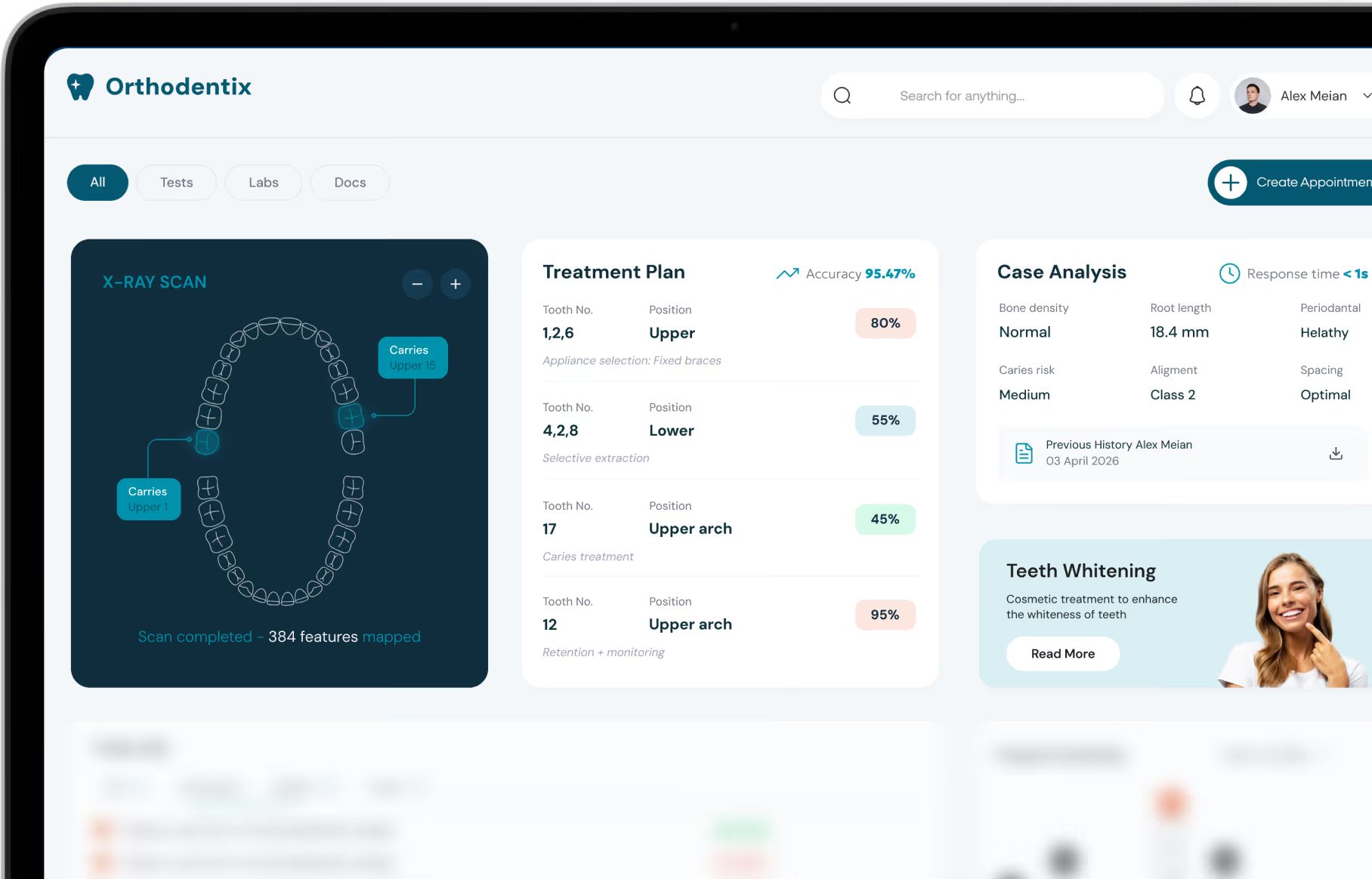
Before any language model writes a word, an ML engine extracts 384 dental features from imaging and volumetric data. Multi-output models then predict the treatment pathway, including appliance choice and extractions, in under a second.
One model writes, a second one checks
A large model drafts the clinical plan. A separate, specialised model audits the draft, strips colloquial phrasing and enforces a formal medical voice. Splitting the jobs made each model better at its task and made the system easier to reason about under audit.
Block contradictions before the LLM sees them
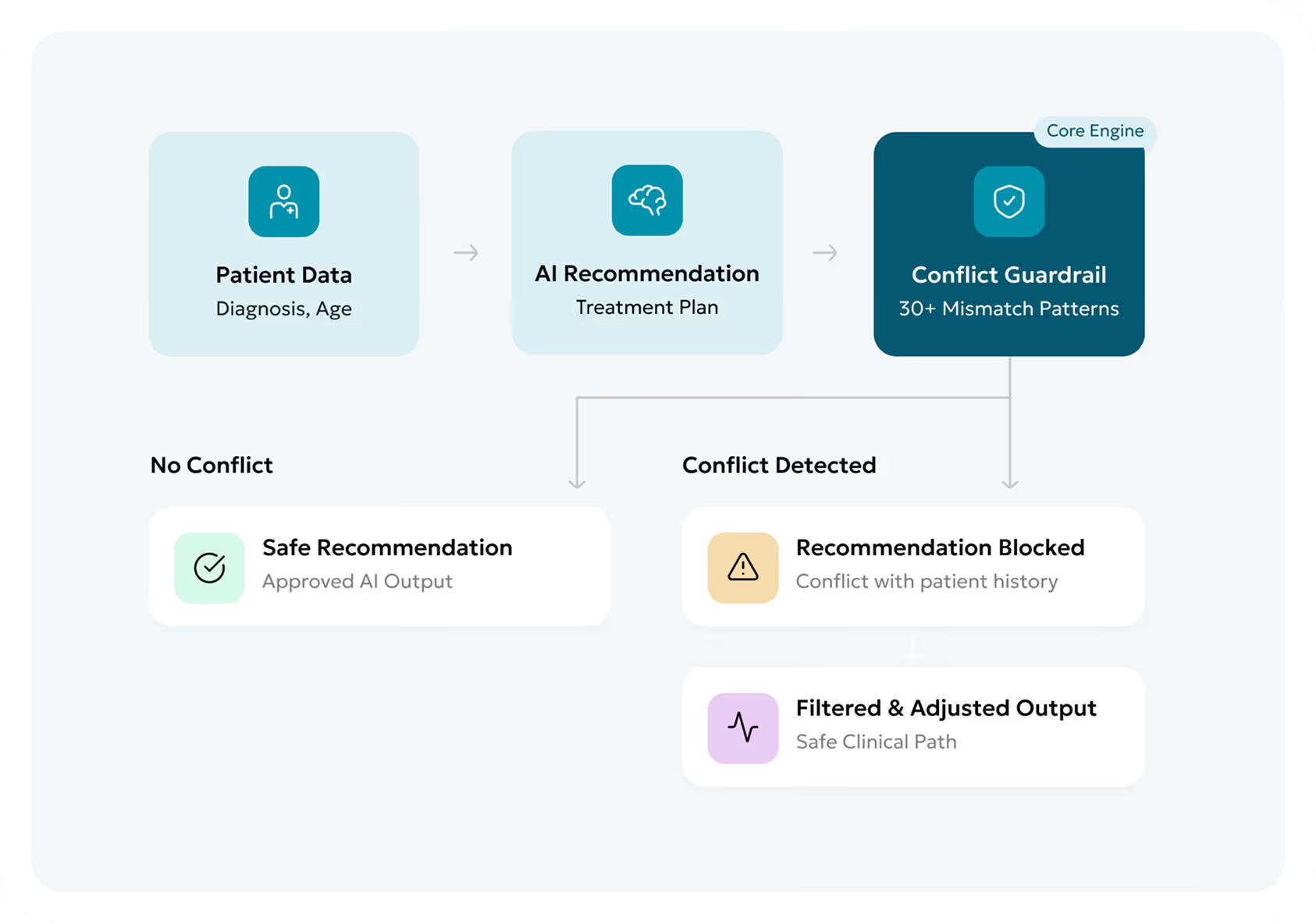
A conflict engine cross-references every AI recommendation against the patient's actual diagnosis. If it finds a contradiction, it filters the context before the language model can act on it, so invented clinical pathways never reach the clinician.
Make data residency part of the architecture
The platform runs on HDS-certified Azure infrastructure, with AES-256 encryption at rest, role-based access and full audit logging. Privacy is built into every layer from storage to inference, so compliance does not depend on a policy document.
Month 1 · Discovery and ML prototyping
Feature engineering from tooth-level diagnostic data.
Month 2 · LLM and RAG integration
Dual-model reporting pipeline and clinical knowledge base.
Month 3 · Clinical calibration
Conflict guardrails and tone-correction datasets.
Month 4 · Production readiness
Move to HDS-certified Azure, performance tuning.
Ongoing · Online learning
Run by the client's team, refined per practice.
The client's team runs the learning loop
The platform is a co-pilot. It pre-analyses each case, drafts the report and flags inconsistencies, and the orthodontist remains the sole legal authority for every plan.
Version 1.0 was handed over to the client's team, which now runs the continuous online learning loop. Clinician-approved corrections are buffered and trigger QLoRA fine-tuning in a sandboxed shadow environment, and updated weights go live only after the lead orthodontist verifies the performance difference.
100%
of patient data inside HDS-certified EU hosting
15+ hrs
reclaimed per provider each week
384
dental features analysed per case
4.3 mo
shorter average treatment duration
80×
faster analysis of diagnostic images and case data
−52%
treatment planning time, 25 minutes down to 12
95.47%
treatment-pathway prediction accuracy
15+ hrs
reclaimed per provider per week
4.3 mo
shorter average treatment duration
30+
clinical mismatch patterns guarded against
Delivered as integrated epics covering the ML diagnostic engine, the dual-model reporting layer, conflict guardrails, a compliance dashboard and the online learning loop.
NestJS · Prisma · Python 3.13 · PyTorch · Hugging Face Transformers · DICOM · FHIR · Azure Health Data Services (HDS) · NVIDIA H100 / A100 · ROUGE / BERT semantic scoring
Questions about this project
How does AI ensure clinical accuracy in orthodontic treatment planning?
The system uses a dual-layered approach. A high-dimensional ML engine analyses 384+ tooth-level features and predicts the treatment pathway with 95.47% accuracy. Every AI recommendation is then cross-referenced against 30+ clinical mismatch patterns by the conflict guardrail engine before it reaches the clinician. Hallucinations are filtered out before they ever surface in a plan.
What are the requirements for health-data residency (GDPR / HDS) in Europe?
Any dental or medical platform operating in the EEA must satisfy all six scopes of European health-data hosting. In practice, this means HDS-certified (Hébergeur de Données de Santé) cloud instances, AES-256 encryption at rest, and role-based access control, designed in from the start.
How does an AI ecosystem reduce documentation load for dental clinics?
By automating the path from raw diagnostic data to a professional, legally-defensible report, the platform reclaims around 15 staff hours per provider per week. Documentation velocity in this engagement increased by 52%, so clinicians spend more time on patient care and less on manual charting.
What is online learning in a medical AI context?
Online learning lets the model evolve based on real clinician feedback. When a doctor corrects or approves a plan, that signal is buffered and used to trigger verified QLoRA fine-tuning cycles in a sandboxed environment. Updated weights are only promoted after a clinical lead reviews the performance delta. The system adapts to the practice over time, but only under human oversight.
Does this AI ecosystem replace the orthodontist in the planning process?
No. In the European medical landscape the doctor is the sole legal authority for every plan, and the system is built to reinforce that. It is a clinical intelligence co-pilot: it pre-analyses 384+ features, drafts the report and surfaces inconsistencies, but every final plan is reviewed and signed off by the clinician. The goal is to give the doctor 15+ hours back to spend on complex biomechanical decisions, not to take any of those decisions away.
What does a platform like Orthodentix typically cost to build?
A platform with this level of clinical and regulatory depth (ML diagnostic engines, dual-model LLM architecture, HDS-certified infrastructure, audit-grade compliance) typically sits in the $150,000–$350,000+ range, depending on the depth of the clinical knowledge base and the sophistication of the online learning loop. The number that matters for your business case is the 5-year total cost of ownership and the rate at which clinical capacity is reclaimed.
See more cases








Is documentation capping your clinicians' capacity?
Tell us what you are building. We will come back with an honest view of how we would approach it.