Book a call
Contact
What we do

Healthcare Software Development Services

Build clinical-grade software with a team that understands both code and compliance.
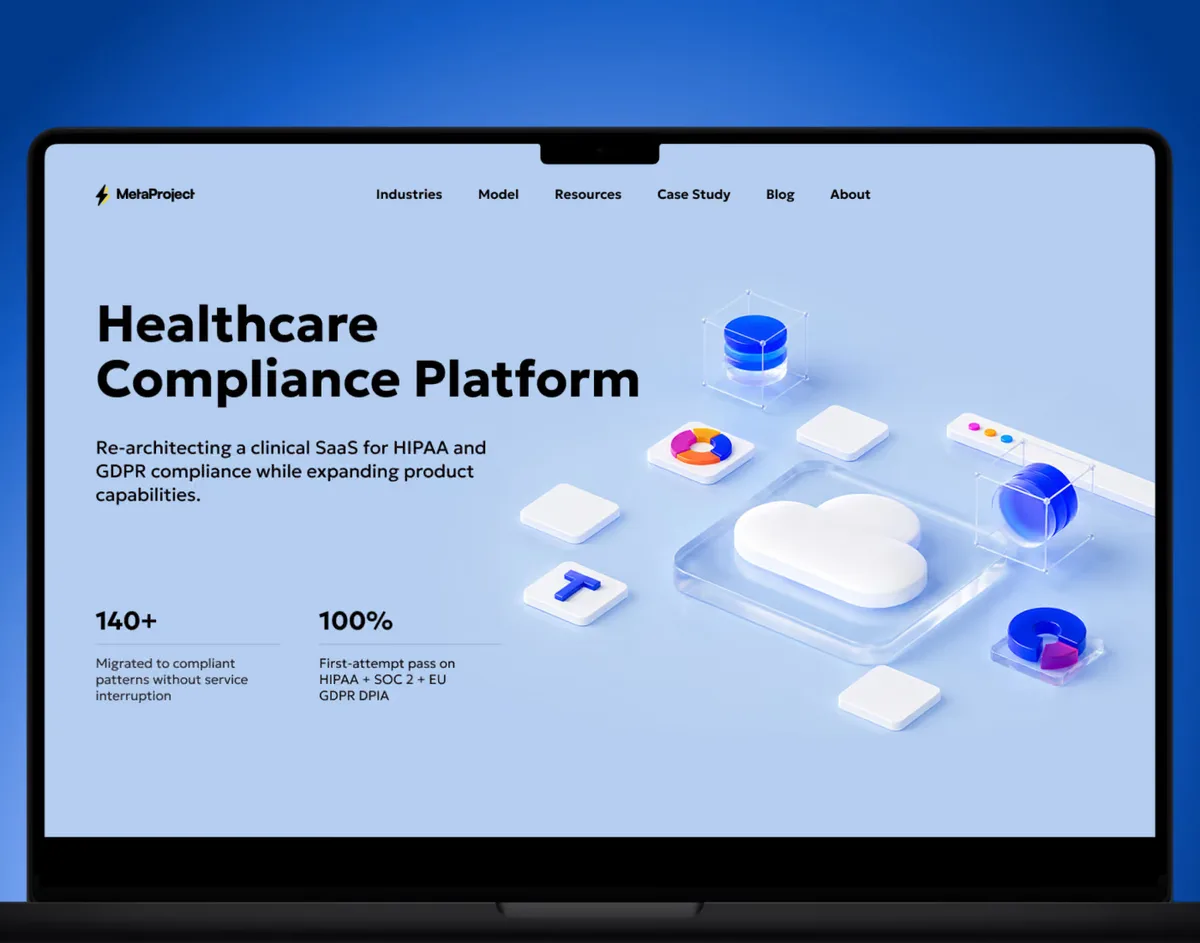
MetaProject provides healthcare software development services for teams building clinical-grade products under HIPAA, HITRUST, and GDPR.
The patterns that work in B2C SaaS — fast-and-loose iteration, "we'll bolt on compliance later," generic identity flows — fail under real healthcare scrutiny. We help you ship clinical workflows, EHR integrations, and AI/ML features to production without violating the privacy rules they sit close to — and we build the internal capability to maintain them.
Book a call

Who we work with

Clinical decision-support platforms integrating with EHRs and handling PHI at scale
Telehealth and virtual care Companies with stringent uptime and privacy requirements
Digital therapeutics (DTx) Seeking FDA Class II clearance and EU MDR conformity alongside the engineering work
Medical imaging and AI/ML diagnostic platforms Balancing model performance, latency, and clinical traceability
Health-system internal platforms Modernising provider workflows under HITRUST or NIST 800-53
Healthcare payor and benefits platforms (invoicing, treasury, AP) integrating with banks and ERP systems

What makes healthcare engineering different

1.
Compliance is a property, not a project
HIPAA is not something you "complete" — it's a continuous state of the system, the team, and the process. Architectures that treat compliance as a one-time effort get rebuilt the next time an audit changes scope. We design for the long game.
2.
The stakes are higher
Downtime, data exposure, and incorrect outputs in healthcare have consequences that don't show up on a SaaS dashboard. We bring patterns from contexts where this is taken seriously.
3.
Talent is scarce
Engineers with both modern cloud-native skills and healthcare-compliance experience are rare — most teams can hire one or the other. We bridge that gap and train your team along the way.

What we build

Compliance-aligned architecture
System architectures with HIPAA, GDPR, HITRUST, and SOC 2 controls embedded as architectural properties, not bolted on later:
PHI domain
boundaries with explicit classification at every interface
Encryption-in-transit
and at rest by default, with key management aligned to compliance requirements
Audit logging
as a first-class architectural concern (tamper-evident where required)
Identity and access models
that scale beyond ad-hoc role tables
Data residency
patterns for US/EU dual deployment
DevSecOps for regulated software
In healthcare you can't separate security engineering from delivery engineering. We build pipelines and practices that satisfy both:
Pipeline security gates
tuned to PHI-handling services (SAST, dependency and secret scanning).
Audit logging
and evidence collection mapped to HIPAA, HITRUST, and SOC 2 at once.
SBOM and signed
artifacts for procurement by enterprise health systems.
Runtime detection
and incident runbooks calibrated to clinical risk.
EHR integration architecture
Almost every healthcare product touches EHRs, and the integration story is rarely simple:
High-availability clinical platforms
Clinical software has uptime expectations closer to financial infrastructure than to consumer apps:
Multi-region deployment with active-active or active-standby patterns
Graceful degradation (a critical workflow keeps functioning even when peripheral services are down)
Defensible SLAs/SLOs for hospital and health-system contracts
Disaster recovery with RPO/RTO calibrated to clinical risk
The underlying scale and reliability capability is covered on Platform Engineering.
AI/ML in healthcare
If your product uses ML or LLMs in clinical workflows, the engineering challenges multiply — model traceability, explainability, drift monitoring, PHI handling in training and inference, and a clear story for regulators:
ML/LLM ops aligned to FDA "Good Machine Learning Practice" principles
Inference pipelines that respect PHI boundaries
Evaluation and monitoring frameworks that satisfy clinical review
Capability transfer for healthcare teams
The point isn't to make us indispensable — it's to leave you with:
A documented architecture and engineering handbook your team owns
Trained internal "compliance champions" who can review code for HIPAA/GDPR implications
Runbooks for incident response, audit preparation, and operational continuity
A skills matrix mapping each capability to internal owners

How we work

Our engagements follow three phases — Co-execution on critical scope → Transition (your team leads, we mentor and codify) → Self-sufficiency (your team owns the practice, we step back to strategic counsel). A typical healthcare engagement runs 9–12 months, depending on scope and starting state. We don't run 3-year retainers — that's what "exit by design" means. More: Delivery as Training, Exit by Design.

Why teams choose us for healthcare work

Senior-only
Every engineer on your project has prior healthcare-compliance experience. We don't learn HIPAA on your time.
Embedded, not outsourced
We work alongside your team, in your repos, on your real problems.
Documentation-first
Everything we build lives in your systems, not in a private vendor knowledge base.
Exit-aware from kickoff
Transition timelines and self-sufficiency milestones are defined in week one.

When to bring us in

You're preparing for HIPAA, HITRUST, or SOC 2 and want controls baked into engineering, not added under audit pressure.
You're selling to enterprise health systems or payors with procurement requirements you don't yet meet.
You're building an AI/ML or LLM-powered clinical product and need a defensible engineering story for regulators.
You're modernising a legacy clinical platform without freezing the product roadmap.
You're building a US/EU dual product with data-residency, GDPR, and state-level US requirements to satisfy.

F. A. Q.

We're early-stage and not yet HIPAA-bound. Should we still architect for it?

If healthcare is your trajectory, yes — but pragmatically. We help early-stage teams identify the small, high-leverage decisions that preserve HIPAA-readiness without overbuilding. Retrofitting HIPAA into an architecture that ignored it is significantly more expensive than designing with it in mind from week one.

Do you work with US, EU, or both?

Both. We have engineers experienced with HIPAA (US), GDPR (EU), and dual-residency patterns. Most modern healthcare products eventually need both.

Can you help us prepare for an FDA submission?

We are not a regulatory affairs firm and we don’t write FDA submissions. But we work alongside your regulatory team to ensure the engineering practices, documentation, and traceability your submission depends on are in place and defensible.

We use a third-party EHR integration platform (Redox, Particle, Health Gorilla). Do we still need integration architecture work?

Often, yes. These platforms simplify the wire-level integration but don’t solve the deeper questions: how integration data flows through your product domain, where your boundaries are, how you handle reconciliation, how you handle EHR-specific edge cases. We’ve worked with all the major aggregators and direct integration patterns.

Our team is small. Will an embedded model work?

Embedded models work well from team sizes of about 8 engineers and up. For smaller teams, we sometimes recommend starting with a Capability Blueprint Workshop to identify the highest-leverage areas first.

Get an honest read on your healthcare platform's compliance and engineering gaps
In a 4-week Blueprint Sprint, we assess your architecture, compliance posture, and engineering practices against clinical and regulatory reality — and produce a roadmap your team can start running immediately.
Start your Blueprint Sprint