Book a call
Book a call
What we do

SaaS Development Services

Expand engineering capability and delivery capacity — without expanding headcount at the same rate.
MetaProject provides SaaS development services for B2B and product companies at the inflection point between $5M and $50M ARR — where revenue grows 30–50% a year, headcount grows too, but feature delivery doesn't keep up.
The honest answer is rarely "more engineers." It's a different operating model: clearer service boundaries, a proper internal platform, a Centre of Excellence that owns architectural decisions, and an engineering practice that scales with the business instead of being rebuilt every time a senior leader changes. That's the engagement we run — embedded alongside your team, with knowledge transfer as a deliverable.
Book a call

Who we work with

B2B SaaS scaling from MVP to enterprise — moving from product-market fit to multi-tenant, enterprise-grade architecture
Vertical SaaS in regulated or specialised industries (healthcare, fintech, logistics, regtech) needing both domain depth and engineering discipline
Horizontal B2B platforms (CRM, ERP, martech, devtools, productivity) scaling to mid-market and enterprise
Product companies replatforming — off a monolith, modernising legacy stacks, or migrating clouds
PLG companies where engineering velocity and product surface area both expand at once
Enterprise software vendors needing modernisation, multi-cloud, or post-acquisition integration
Organisations between founder-led and process-driven — typically 30–150 engineers

What makes engineering here different

1.
The constraint shifts from "shipping features" to "shipping features without slowing down."
The architecture and practices that supported the first 50 features become the bottleneck for the next 50. The work is less "build the thing" and more "structure the system so the team can keep building it."
2.
Multi-tenancy is harder than it looks.
Most platforms inherit shared-database, tenant-ID multi-tenancy from the MVP. Patterns that work at 100 customers fail subtly at 10,000, and enterprise customers add requirements — data residency, single-tenant deployments, custom domains — the original design never anticipated.
3.
Compliance arrives in waves.
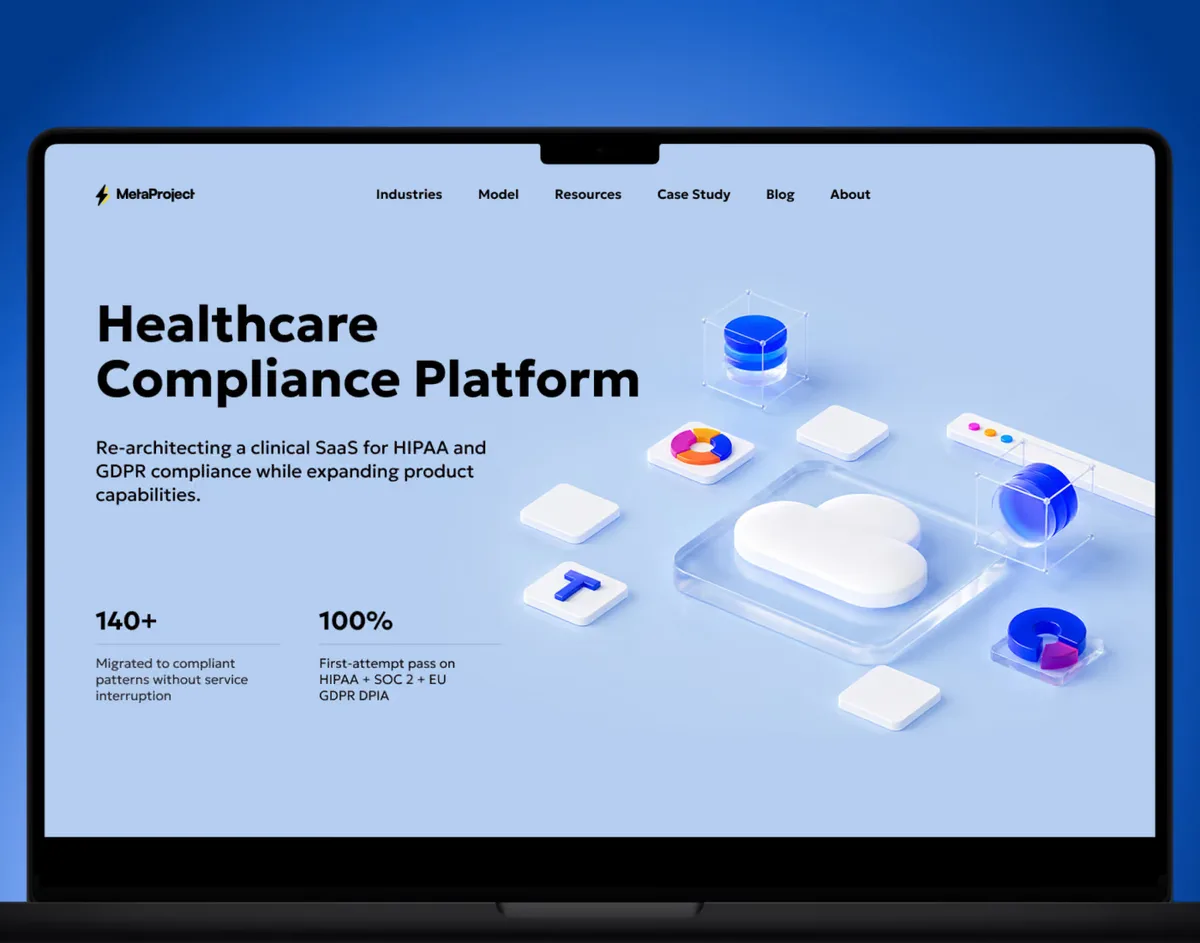
SOC 2 first, then ISO 27001, HIPAA, GDPR, PCI-DSS. Each adds engineering requirements; together they dominate the roadmap unless the architecture absorbs them as properties rather than projects.
4.
Engineering capacity is a portfolio problem.
Product, platform, compliance, tech debt, security, and modernisation all compete for the same engineers every quarter. Companies that scale well have an explicit model for allocating across these; the ones that struggle treat each as an emergency.

What we build

Engineering organisational design
Team topology matched to your product domains, an architectural ownership model (who owns standards, who decides, who reviews), a lightweight operating model, and hiring blueprints. See Product & Delivery Operating Model.
Centre of Excellence design
A small internal CoE (5–8 senior engineers, sometimes rotating) that owns architectural standards and platform direction without taking authority from the squads — staffed from your own engineers, not from us. See CoE Design & Transition.
Platform engineering
An internal developer platform with self-service deployment, service catalogue, paved roads, standardised observability and secrets, and FinOps from the start. See Platform Engineering.
Architecture standards and ADRs
Documented decisions in your repos — standards for API design, eventing, persistence, and observability, plus federated review that scales beyond one bottleneck architect. See Software Architecture Consulting.
Compliance as an engineering property
SSDLC playbooks aligned to the frameworks your customers care about, automated CI/CD security gates, audit evidence as a build artifact, and multi-framework control mapping so one decision satisfies several audits. See DevSecOps Consulting.
Modernisation and replatforming
An honest assessment of what to replatform, refactor, replace, or retain; strangler-fig migration that doesn't freeze the roadmap; and multi-tenant redesigns where the original pattern no longer scales. See Legacy & Application Modernization.
Capability transfer
Documented decisions, trained internal architects and platform engineers, a skills matrix, and an operating-model handover with defined exit milestones. See Exit by Design.

How we work

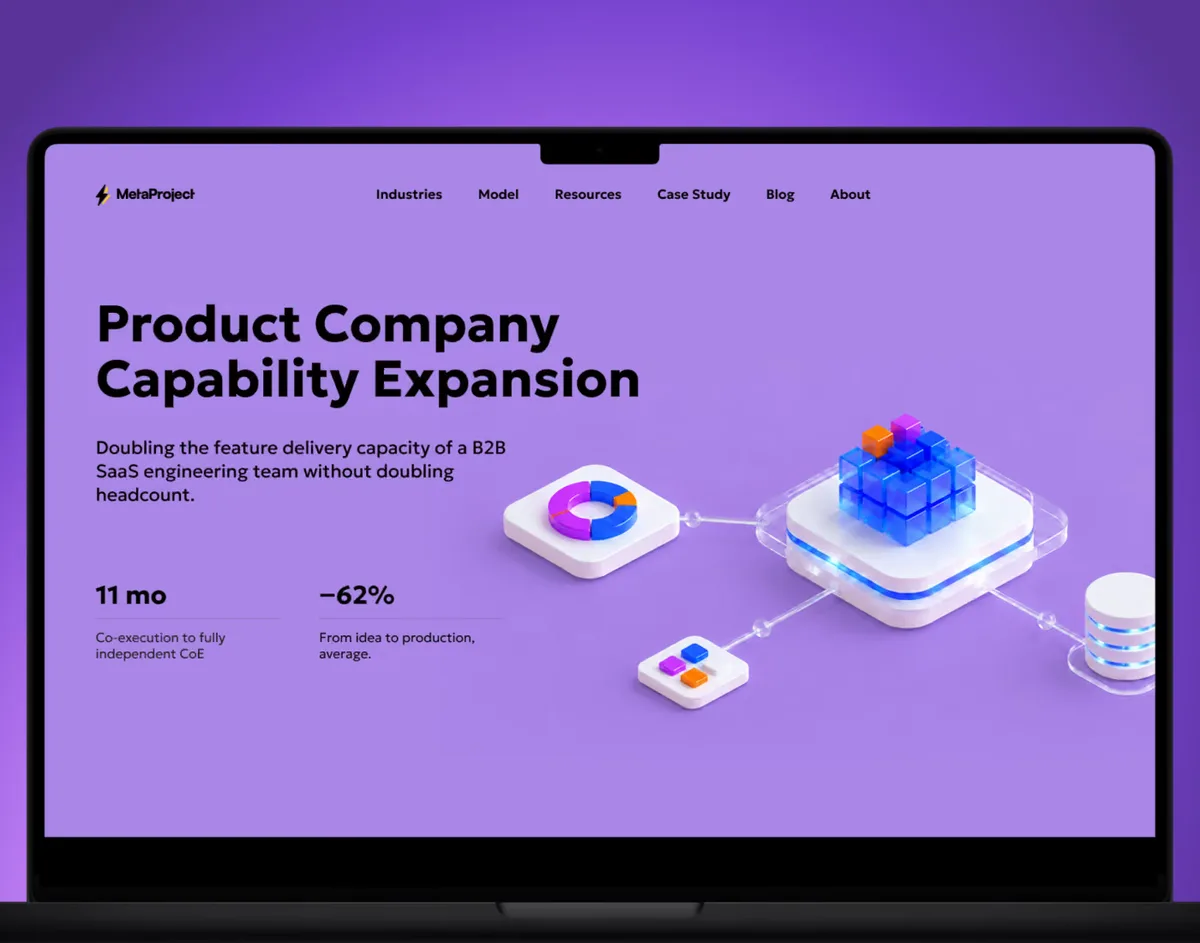
Our engagements follow three phases — Co-execution → Transition → Self-sufficiency — and typically run 9–14 months. For org design plus platform plus initial CoE work, the longer end is normal. More: Delivery as Training.

Why teams choose us for SaaS work

Senior-only
Every engineer has scaled B2B SaaS through similar inflection points. We don't learn multi-tenancy patterns on your time.
Honest about what doesn't scale
We've helped teams retire microservices that shouldn't exist, keep monoliths that should stay, and stop platform work that wasn't earning its cost. "Stop doing this" is often worth more than another sprint.
Embedded, not outsourced
In your repos, on your real platform.
Exit by design
Your team operates what we built — critical for product companies whose edge depends on engineering autonomy.

When to bring us in

You're approaching a delivery-capacity ceiling — revenue grows, delivery doesn't, despite hiring.
You're preparing for enterprise customers and SOC 2 / ISO 27001 moved from "nice to have" to "required for the next deal."
Architectural drift — independently reasonable squad decisions produced an inconsistent platform that's painful to onboard into.
You're replatforming or migrating and need to do it without freezing the roadmap.
You're coming out of an incident or audit and want to rebuild the discipline, not patch the hole.
A senior engineering transition (VP/CTO/foundational engineer leaving) and you need to consolidate knowledge into the team.

F. A. Q.

At what stage do product companies benefit from this?

Most engagements land in the 30–150 engineer range, at $5M–$50M ARR. Earlier, the constraint is usually product-market fit; later, large enterprises need governance and consolidation. The signal isn't size — it's the feeling that the structures that got you here won't scale further.

We're considering hiring a VP Engineering. Should we do that instead?

Not instead — alongside. A strong VP is necessary and we're not a replacement. We add a senior team doing architectural and platform work in parallel with the VP's org and people work, and we transfer that capability to internal owners. Several engagements start right after a VP hire, to give them a foundation.

Do you do staff augmentation?

No. Staff augmentation drops engineers in to do work you direct — a legitimate model, just not ours. We lead architectural and operating-model work and end with your team owning the practice. Poor fit if you want hands without judgement; good fit if you want architects whose job is to make themselves unnecessary.

Will we end up dependent on you?

No, by design. The transition timeline is set at kickoff, documentation lives in your repos from day one, the CoE is built from your engineers, and the skills matrix is verified before we step back. See Exit by Design.

Can you help with a specific compliance framework?

Yes — and teams preparing for one (usually SOC 2) benefit from architecting for several at once, since controls overlap across SOC 2, ISO 27001, HIPAA, GDPR, and PCI-DSS. See DevSecOps Consulting.

Get an honest read on where your engineering organisation is losing leverage
In a 4-week Blueprint Sprint, we assess your operating model, architecture, and platform — and produce a roadmap calibrated to your stage and business reality.
Start your Blueprint Sprint