Book a call
Contact

Context

A growing B2B SaaS company — operating across Europe and North America, serving mid-market and enterprise clients — had hit a familiar wall. Annual revenue was growing 40% year-over-year. Engineering headcount was growing too, but feature delivery wasn't keeping up. Every new hire took six months to become productive. Every architectural decision required either a long debate or a vendor recommendation. The CTO faced an uncomfortable choice: keep hiring at a rate that compressed margins, or admit that the platform could not scale with the product roadmap.
The board had previously approved bringing in a Tier-1 consultancy. The result was a 90-page strategic recommendation, no operational change, and a follow-on engagement quote that exceeded the engineering budget for the year. The CTO wanted something different: a partner that would build the company's own capability to deliver, rather than become a permanent line item.

This is the engagement we describe here.

The problem

Discovery surfaced a set of compounding constraints:
Architecture drift
Eight squads, each making independently reasonable decisions, had produced eight slightly different service patterns. Onboarding a new engineer meant learning eight conventions.
No platform team
Every squad maintained its own deployment scripts, observability config, and CI/CD pipelines. Tooling work was duplicated across squads.
Long lead time on cross-cutting changes
A change touching multiple services took three weeks to coordinate. Architecture review meetings ran weekly but produced few binding decisions.
Knowledge concentration
Three senior engineers held most of the operational knowledge. When one of them was on holiday, certain releases simply did not happen.
Hiring slowdown
The company had been trying to hire two senior platform engineers for nine months without success. The talent market was tight, and the role description had no clear scope of authority.
This wasn't a technology problem. It was a capability problem dressed up as one.

What we built together

MetaProject embedded a small senior team (four engineers + one engineering coach) alongside the client's existing squads. Over eleven months, we focused on five capability layers, each transferred to the internal team before we moved on.
01
Architecture standards
We codified the eight diverging service patterns into one. We documented APIs, error handling, eventing, persistence, and observability conventions. New service templates were generated from the standard, so squads couldn't easily diverge again. Every standard was tied to an Architecture Decision Record (ADR) explaining the trade-off.
02
Internal Developer Platform (IDP)
We bootstrapped a platform team from two existing senior engineers (rather than waiting on external hires). We built a self-service deployment flow on Kubernetes with GitOps, an internal service catalog, and a paved road for new services. Onboarding time for a new engineer dropped from six months to six weeks.
03
Product delivery operating model
We re-shaped the squad structure around stable product domains rather than projects. We introduced a flow-of-work model with explicit WIP limits, prioritization forums tied to business outcomes, and lightweight architecture governance through a federated review group. The endless architecture review meetings were replaced by asynchronous ADR reviews with named decision owners.
04
Centre of Excellence transition
We helped design and stand up the company's internal Engineering CoE — a small group (five senior engineers, rotating) that owned architectural standards, platform roadmap, and engineering practices. We did not staff the CoE. We trained it.
05
Knowledge transfer systems
Every artifact we produced lived in the client's own systems from day one. We co-wrote the engineering handbook. We ran weekly internal tech talks that grew into a regular practice the team continued after we left. We built a Skills Matrix mapping each capability to who in the team owned it.

Timeline

This engagement followed a longer-than-typical version of our three-phase model, because the client wanted us to also help with the platform team build-out:
Phase 1
Co-execution (months 1–5)
MetaProject led the architecture standards rollout, built the first version of the IDP, and chaired the architecture forum. Client engineers paired on every change. By month 5, two client engineers had become co-leads on the platform.
Phase 2
Transition (months 6–9)
Client engineers led platform work, ran the architecture forum, and drove standards evolution. MetaProject moved into mentor and reviewer roles. The CoE was formed. We co-designed the operating model with the client's VP Engineering.
Phase 3
Self-sufficiency (months 10–11)
Internal CoE owned all standards, platform, and architectural decision-making. MetaProject stepped back to monthly check-ins and ad-hoc strategic counsel.

Outcomes

Eleven months after engagement start:

2.1×
2.1× feature delivery capacity
at the same team size, measured in story points and confirmed in product roadmap velocity
4× deployment frequency
from weekly to multiple daily deploys, with no increase in change-failure rate
95.47%
62% lead-time reduction
from idea to production

45%↑
45% reduction in vendor dependency cost
annualized spend on external consulting and contracting
4 mo
Successful senior hires
the platform engineering roles that had been open for nine months were filled within four months of the new operating model, because the role scope was finally clear
CoE
Internal CoE running independently
five engineers rotating, with the company's own architectural roadmap
MetaProject embedded a small senior team (four engineers + one engineering coach) alongside the client's existing squads. Over eleven months, we focused on five capability layers, each transferred to the internal team before we moved on.

Why this engagement worked

We didn't replace the team. We made the team senior
Every change we made was paired with a knowledge transfer step. There was no "MetaProject did this" — there was always a named internal owner.
The CoE was built from inside
We could have parachuted a CoE team in. We didn't. The CoE was assembled from the client's own senior engineers, which made it credible internally and sustainable after we left.
Documentation-first
Every standard, ADR, runbook, and playbook lived in the client's own repos and wiki. When we exited, nothing important left with us.
Exit was a design constraint from day one
The transition timeline was set at kickoff. Every milestone was framed against "what's the team doing without us."

Why this engagement worked

We didn't replace the team. We made the team senior
Every change we made was paired with a knowledge transfer step. There was no "MetaProject did this" — there was always a named internal owner.
The CoE was built from inside
We could have parachuted a CoE team in. We didn't. The CoE was assembled from the client's own senior engineers, which made it credible internally and sustainable after we left.
Documentation-first
Every standard, ADR, runbook, and playbook lived in the client's own repos and wiki. When we exited, nothing important left with us.
Exit was a design constraint from day one
The transition timeline was set at kickoff. Every milestone was framed against "what's the team doing without us."

Stack snapshot

Cloud
AWS (multi-region, multi-account with org-level guardrails)
Compute
EKS, Lambda, Fargate
Data
PostgreSQL (RDS, Aurora), DynamoDB, Kafka (MSK) for eventing
Platform
ArgoCD, Backstage as service catalog, Terraform / Crossplane for IaC, OpenTelemetry across stack
CI/CD
GitHub Actions with shared workflows, SAST/SCA gates, SBOM generation
Observability
Grafana, Prometheus, Loki, OpenTelemetry traces; SLO/SLI dashboards per service
Engineering practices
ADRs in the main repo, monthly architecture forums, federated reviews

Want to expand your team's capabilities without expanding your team?

If your engineering organisation is growing but delivery isn't keeping up — and you suspect the answer is a stronger internal operating model, not more he
Start a Capability Blueprint Workshop
Client name withheld under NDA. Outcomes verified through joint post-engagement review.

See more cases

Welcome Renovation

Engineering a productized renovation experience for the California luxury market — three apps, one source of truth.
#PropTech
#ConstructionTech
#Mobile
#iOS
#Android
#Stripe
#AWS
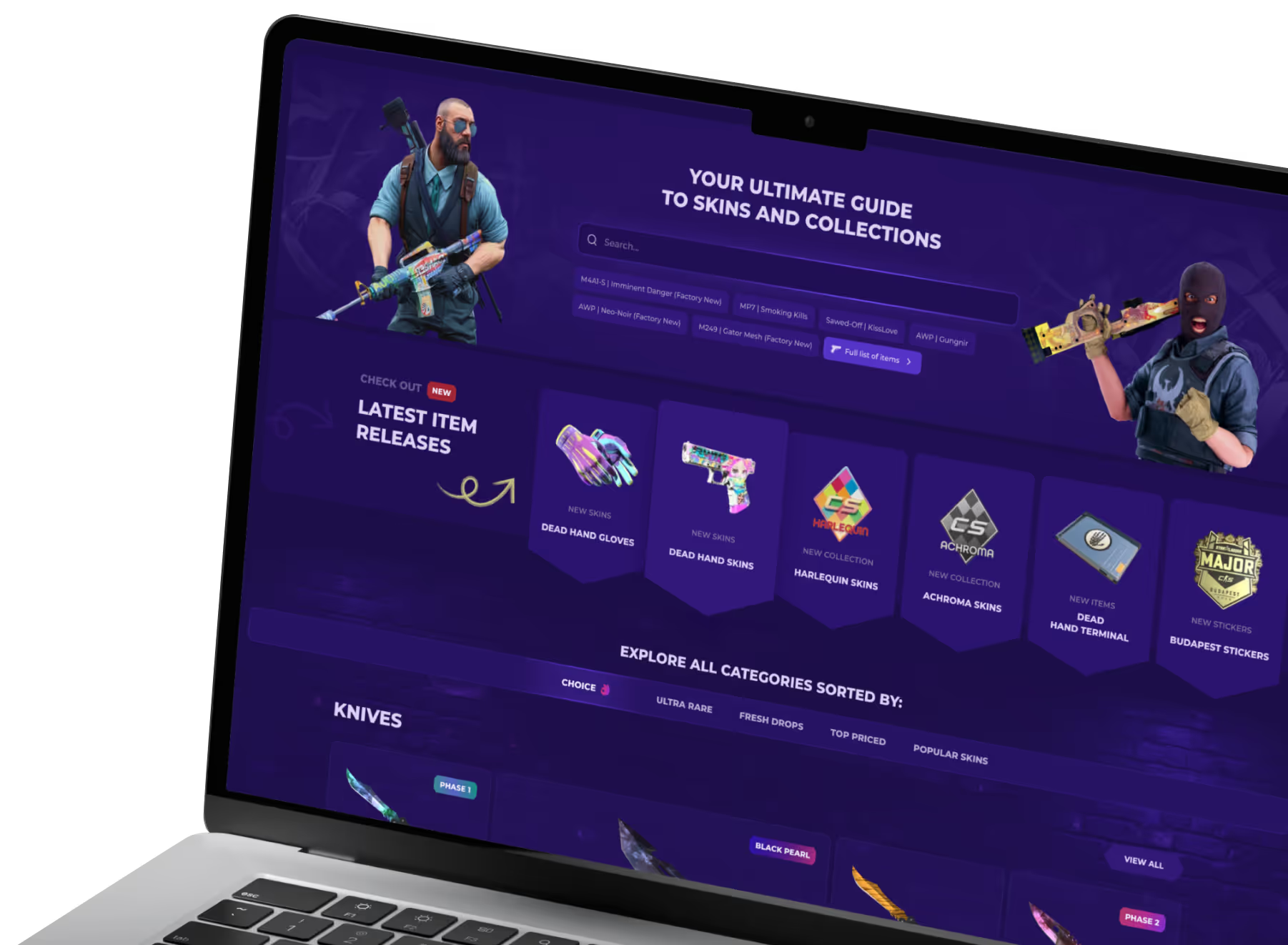
Skin.Club CS2 skins guide webpage displaying various weapon skins and knife designs including Doppler, Ultraviolet, Marble Fade, Freehand, and Damascus Steel.
This is some text inside of a div block.

Healthcare Compliance Platform

Re-architecting a clinical SaaS for HIPAA and GDPR compliance while expanding product capabilities.
#HealthTech
#Compliance
#HIPAA
#Kubernetes
#GDPR
#Cloud-Native
#Microservices
#AWS
#PostgreSQL
DevSecOps
Skin.Club CS2 skins guide webpage displaying various weapon skins and knife designs including Doppler, Ultraviolet, Marble Fade, Freehand, and Damascus Steel.
This is some text inside of a div block.

Singapore Payroll SaaS

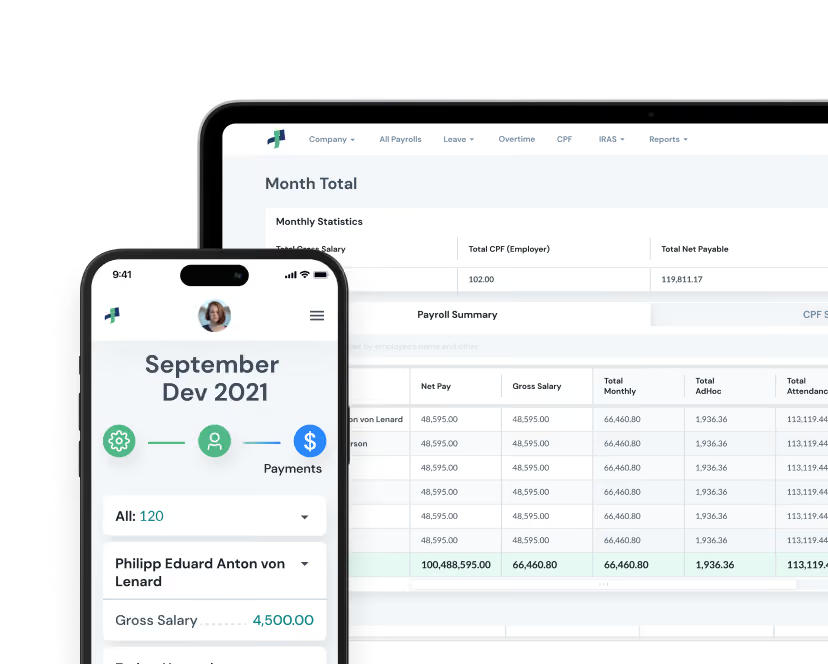
Engineering a regulated payroll and HR platform — 20+ bank integrations, statutory tax automation, and the operational discipline a regulated SaaS demands from day one.
#PostgreSQL
#FinTech
#PayrollTech
#HRTech
#SaaS
#APAC
#.NET
#AWS
Skin.Club CS2 skins guide webpage displaying various weapon skins and knife designs including Doppler, Ultraviolet, Marble Fade, Freehand, and Damascus Steel.
This is some text inside of a div block.
+1
🇺🇸
Uploading...
fileuploaded.jpg
Upload failed. Max size for files is 10 MB.
By clicking this button I agree to the Privacy policy
Thanks for reaching out!
We’ve received your message and one of our experts will be in touch shortly.
Back
Oops! Something went wrong while submitting the form.

Start your capability journey

In 4 weeks we map your architecture, delivery model, knowledge gaps, risks, and capability priorities — so you can scale independently.
Man with short dark hair and beard wearing sunglasses and a light-colored shirt, looking to the side against a blurred outdoor background.
Alexey Belokamensky
CEO
Black and white photo of a man in a suit speaking at a microphone on stage with a piano in the background.
Alex Volt
Head of Sales
Black and white portrait of a woman with curly hair wearing a white top, looking off to the side.
Sofia Petrenko
Recruitment Manager