Book a call
Contact
What we do

Logistics & Supply Chain Software Development

Build platforms for an industry where operations move physical goods through real-world constraints — and the software has to keep up with both.
MetaProject provides logistics software development for shipping, maritime, freight, and supply chain operators — an industry that moves roughly 80% of global trade on software still built for a smaller, slower era: disconnected systems, manual reconciliation, paper-trail dependencies.
Margins are thinner and customers now expect ecommerce-grade visibility. The operators who thrive are the ones whose software lets them grow operations without proportionally growing back-office headcount. We work embedded — senior engineers building the architecture and codifying the practice your team owns after we leave.
Book a call

Who we work with

Maritime and shipping operators managing fleets, vessel lifecycle, port operations, and international logistics
Freight forwarders and 3PL providers running multi-mode logistics across air, ocean, road, and rail
Supply chain platforms providing visibility, planning, or execution across distributed networks
Warehouse management (WMS) teams modernising operations at scale
Transportation management (TMS) teams building or replatforming for multi-modal complexity
Last-mile delivery platforms balancing routing, driver tooling, and customer-facing visibility
Customs, trade-compliance, and documentation platforms absorbing jurisdictional variation
Cold chain, hazardous cargo, and specialised logistics with their own compliance layers

What makes this industry different

1.
Operations cannot pause.
Maritime fleets don't stop for cutover weekends; trucks don't reroute around your deployment window. Software work has to integrate with operations running continuously, across time zones, with real economic consequences for downtime. Migration patterns that work in B2B SaaS fail here — the business does not get to freeze.
2.
The data layer is messier than most.
Logistics inherits data from EDI feeds, partner APIs, legacy systems, paper documents, and sensors — much of it inconsistent, late, or contradictory. Platforms that work here treat reconciliation, normalisation, and conflict resolution as first-class concerns.
3.
Regulatory variation is the default.
Customs codes, maritime regulations, hazardous-cargo handling, driver hours-of-service, cross-border documentation, port-specific procedures — each jurisdiction has its own rules, and the software absorbs that variation without exposing the complexity to the user.
4.
Cost discipline scales with operations.
Logistics runs on thin margins, so software that improves operational efficiency by 10–30% has far more business impact here than the same gain in a SaaS product. The architecture choices that cut administrative overhead are the business case.

What we build

ERP and operational core architecture
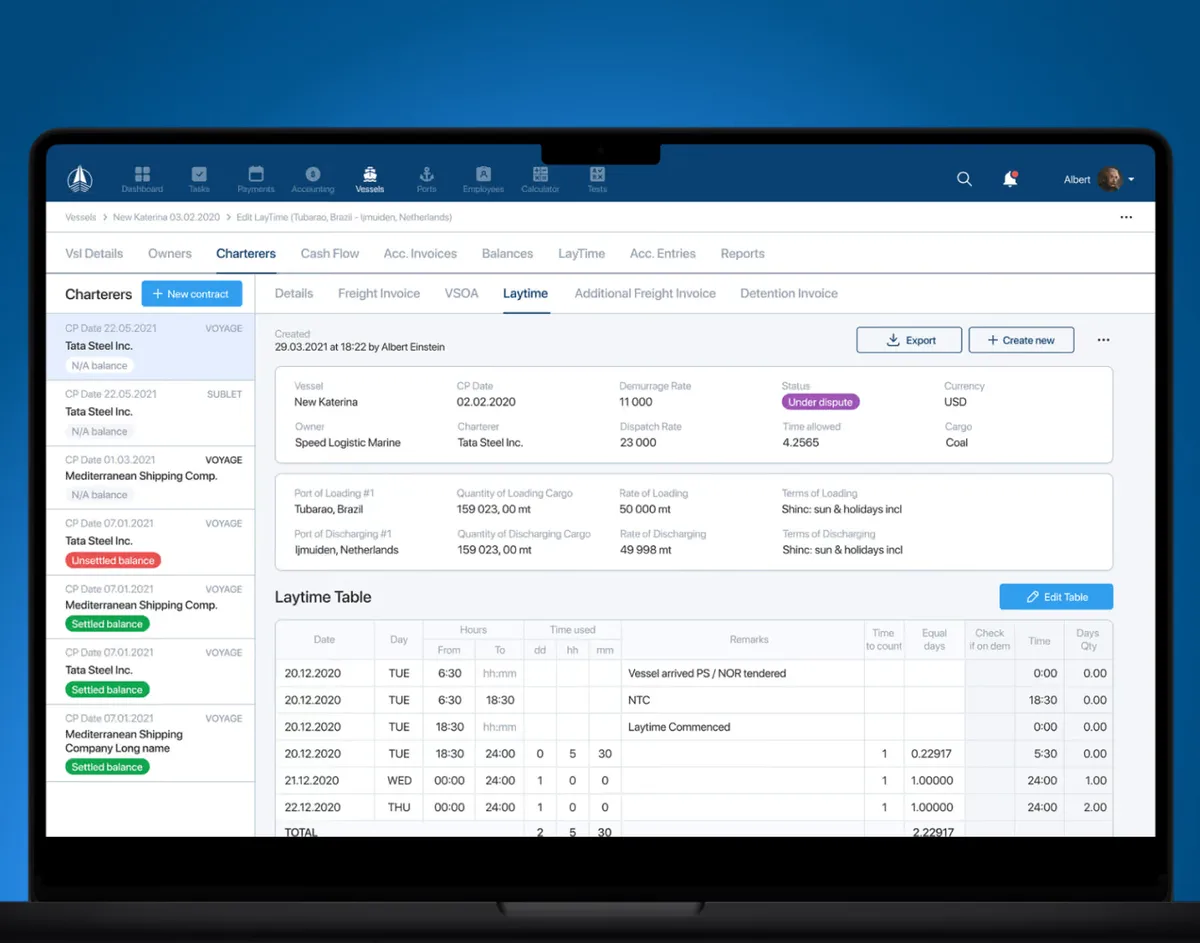
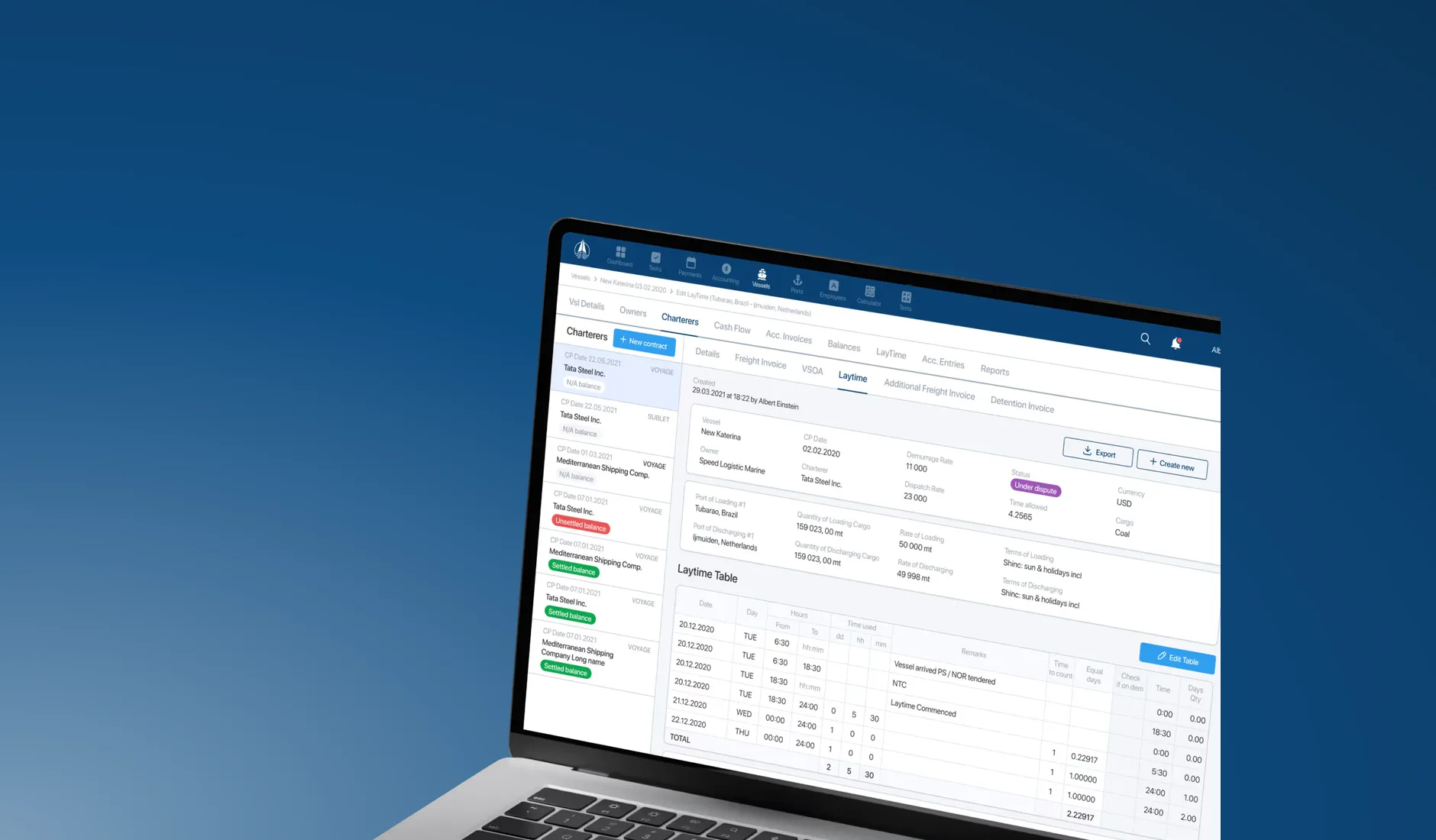
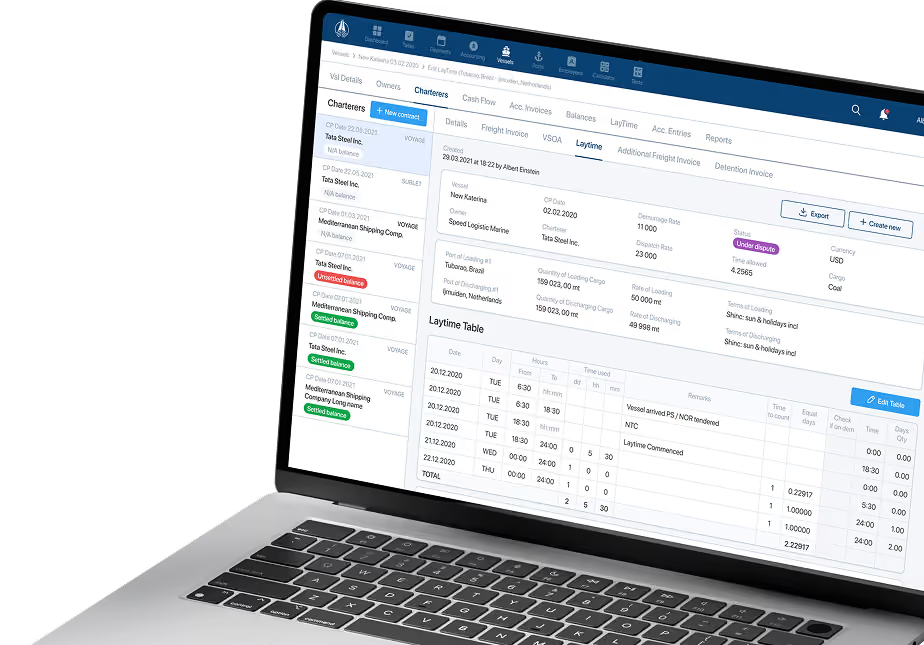
A single source of truth across functions that historically lived in separate tools — unified asset records (vessels, trucks, containers, shipments), multi-currency financial engines, multi-level approval workflows, audit-grade documentation, and integration with existing financial, legal, and CRM systems rather than rebuilding them. See Software Architecture Consulting.
Mobile and field operations
Decisions happen at the edge — at the port, on the ship, in the warehouse. Native or appropriately cross-platform apps, offline-capable workflows for intermittent connectivity, high-resolution media capture (proof of delivery, damage, inspections), location-aware features, and role-specific interfaces for dispatchers, drivers, captains, and port operators.
Real-time visibility and tracking
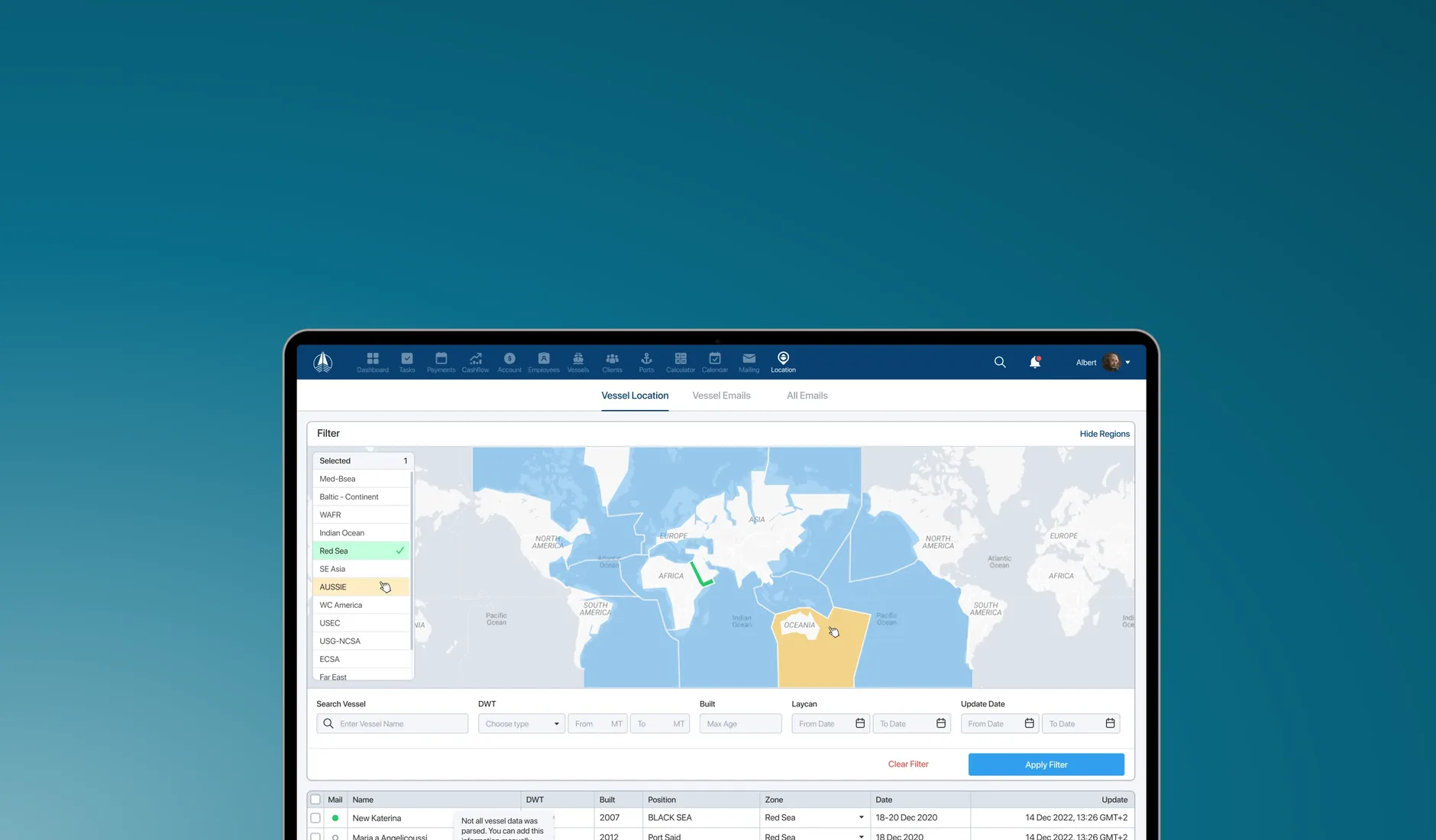
Ecommerce-grade visibility whether the shipment is a parcel or a 200,000-ton vessel — real-time data layers ingesting EDI, partner APIs, IoT, and manual updates; conflict resolution when sources disagree; and customer-facing tracking with sub-second freshness. The underlying scale capability is covered on Platform Engineering.
AI and predictive logistics
Route optimisation, demand forecasting, predictive maintenance, AI-powered correspondence routing, and fuel/cost optimisation — the modules where 20–40% operational improvements are realistic, provided the underlying data is clean enough to support the model.
Compliance and regulatory architecture
Multi-jurisdiction customs and trade documentation, maritime frameworks (IMO, SOLAS, MARPOL), hours-of-service, hazardous-cargo handling, and audit-grade retention — isolated in a compliance layer that absorbs the differences so the user experience stays clean. See DevSecOps Consulting.
Legacy modernization for established operators
Green-screen mainframes, custom ERPs, and end-of-life vendor systems modernised as a long-cycle discipline — honest assessment, strangler-fig migration that doesn't freeze operations, data migration as a first-class workstream, and operational handover designed in. See Legacy & Application Modernization.
Capability transfer
Documented architecture decisions in your repos, trained internal architects, runbooks for the most likely operational scenarios, and a skills matrix — because logistics businesses outlast specific software vendors. See CoE Design & Transition.

How we work

Our engagements follow three phases — Co-execution → Transition → Self-sufficiency — and typically run 9–14 months. For a full ERP build or platform replatforming, the longer end is normal. More on our approach: Delivery as Training and Exit by Design.

Why teams choose us for logistics work
Senior-only
Every engineer has prior production experience with logistics or comparable operational software. We don't learn maritime regulation or multi-currency reconciliation on your time.
Operational discipline
We design for the reality that operations cannot pause — slice-based migration, staged cutover, rollback always available.
Embedded, not outsourced
In your repos, on your real platform.
Exit by design
Your team operates what we built; we don't become a permanent vendor.
Our maritime ERP work with SLM is a representative example — see the SLM case study.

When to bring us in

You're hitting the administrative ceiling — operations grow but back-office headcount grows faster, and the constraint is information architecture, not fleet capacity.
You're replatforming a legacy ERP off a mainframe, vendor system, or in-house build approaching end-of-life.
You're scaling internationally, adding jurisdictions, currencies, languages, or regulatory regimes.
You're building a new logistics product (TMS, WMS, last-mile, visibility) and want the right foundation.
You're integrating AI or predictive capabilities without compromising operational reliability.
You're coming out of an integration gone wrong — vendor lock-in, migration failures, EDI chaos — and want to rebuild the practice.

F. A. Q.

We're a maritime / shipping operator. How is this different from generic logistics?

In scope, mostly the same; in regulatory shape, very different. Maritime carries IMO, SOLAS, MARPOL, port-state, and flag-state requirements that don't apply to road or air. Vessel lifecycle, multi-jurisdiction crewing, bunker logistics, and port operations have their own patterns. SLM is our maritime-specific case study, and the pattern generalises across operators of similar complexity.

Can you help with EDI integrations?

Yes. EDI is one of the messiest data-integration domains in software, and generic patterns underestimate its quirks (inconsistent partner implementations, format variations, late or out-of-order messages). We design EDI as its own workstream with explicit normalisation, reconciliation, and conflict resolution.

How do you handle data migration from legacy logistics systems?

As a first-class workstream. Logistics data is messy — inconsistent vessel records, partial contract histories, federated financial data. The pattern that works is characterisation, transformation rules documented and reviewed, scripted and idempotent runs, automated reconciliation, and staged cutover. Migration typically runs 2–4 months of a 9–14 month engagement.

Can the platform handle peak operational windows?

Yes, though logistics peaks look different from consumer surges — seasonal (peak shipping), event-driven (month-end close, reporting deadlines), or weather-induced (storm-season port ops). Patterns include predictive scaling for known windows, queueing for batch operations, and graceful degradation when partner systems misbehave. See Platform Engineering.

Do you work with both established operators and logistics startups?

Yes, with different engagement shapes. Established operators usually need replatforming, integration, and capability transfer to long-tenured teams; startups need greenfield architecture and patterns that scale. The engineering discipline overlaps; the engagement adapts.

Get an honest read on your logistics platform's gaps.
In a 4-week Blueprint Sprint, we assess your architecture, compliance posture, and engineering practices against your real operational tempo — and produce a roadmap calibrated to your business reality.
Start your Blueprint Sprint