Concretely, that involves:
What we do
Engineering Center of Excellence (CoE) Design
From vendor-reliant to self-sufficient.
Results from our CoE work
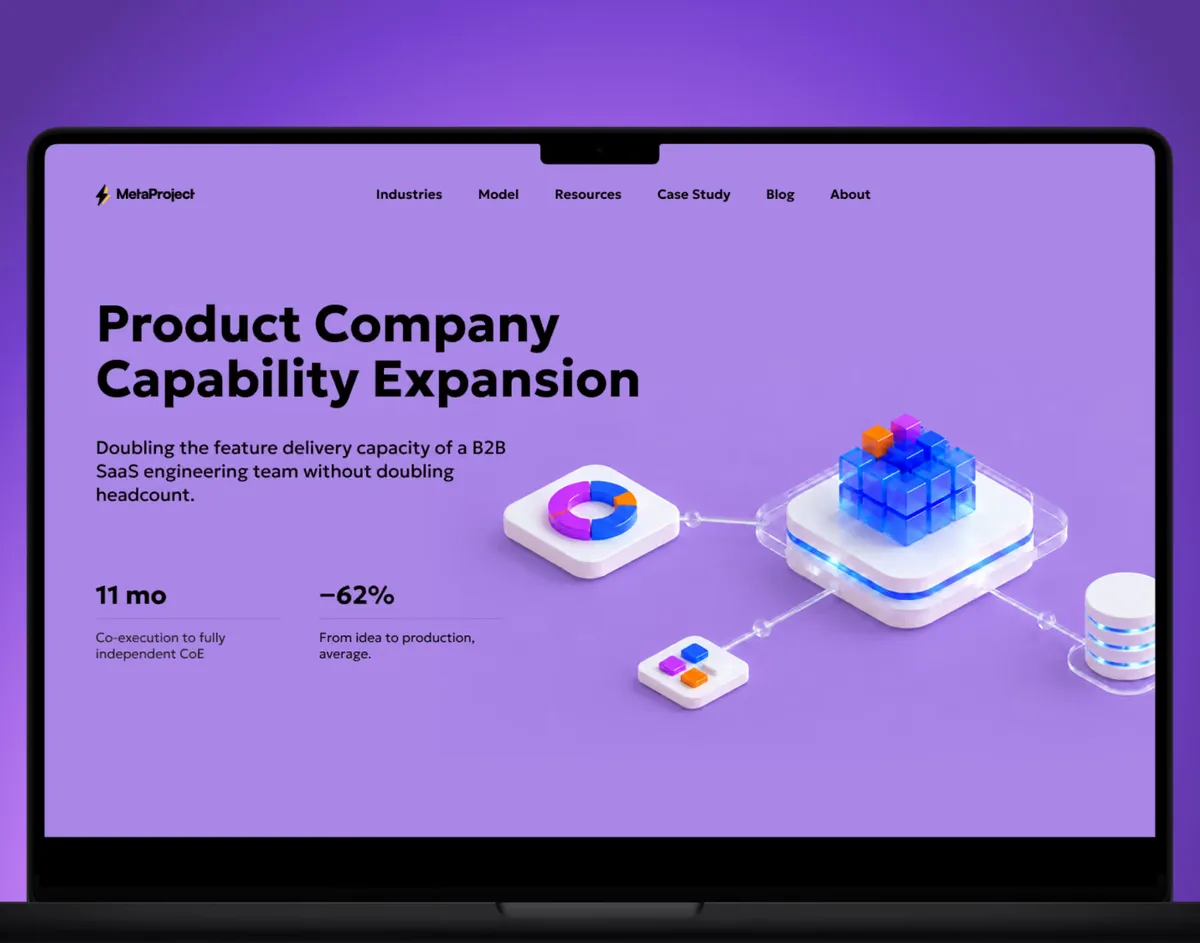
11 mo
from co-execution to a fully independent CoE
B2B SaaS caseMonth 9
when the client team passed its next audits without us
Clinical SaaS case+28pp
senior engineer retention, 18 months after the transition
B2B SaaS caseYou can keep buying resources and expertise, or you can build the capability and take full control over your roadmap.
If architecture and delivery decisions live mostly in vendors’ heads, every new mobile app, web product, or platform change feels risky. Your own engineers are capable, but there’s no clear “home” for standards and their long-term evolution. This capability area is about designing and growing that home: an Engineering Center of Excellence (CoE) that can steward your architecture, platform and delivery model. It also covers planning the transition from “we rely on vendors” to “we run this ourselves”.
What we help you build
We work with you to design and (critically) transition to a CoE that:
Owns architecture & engineering foundations for your mobile, web, and backend systems.
Owns the platform: CI/CD, environments, observability, DevSecOps and developer experience.
Influences the product & delivery operating model: how squads work and how change flows.
Sets standards and guardrails, and coaches every delivery team.
Has a clear mandate, structure and roadmap, and doesn’t turn into an ivory tower.
CoE purpose & scope.
Maturity assessment & target state.
Operating model & governance.
Org design & hiring roadmap.
Capability uplift programmes.
A staged transition plan (and our own exit by design).
Pillar 1
Purpose, scope & mandate
First, we make the CoE’s reason to exist explicit. We align with your leadership on:
Purpose
What problems the CoE is here to solve (e.g. fragmented architecture, slow releases, inconsistent practices).
What success looks like in 12–24 months (e.g. fewer outages, faster delivery, reduced vendor reliance).
Scope
Which domains the CoE owns: architecture, platform, DevEx, engineering practices, internal tooling, etc.
What it does not own (e.g. day-to-day squad delivery, product decisions).
Mandate & authority
What decisions the CoE can make and enforce.
How it influences squads without becoming a bottleneck.
This is the foundation that keeps your CoE from drifting into either toothless advisory or heavy-handed gatekeeper.
Pillar 2
Maturity assessment & target state
We then map where you are today and where you need to be.
Current state
We assess maturity across:
Architecture. Consistency of patterns, clarity of boundaries, presence of ADRs and reference designs.
Platform. Pipelines, environments, observability, and incident practices.
Product & delivery. Ways of working, alignment around outcomes, release governance.
Solution-specific expertise. Mobile, web, SaaS, legacy, high-load, data, security.
People & skills. Seniority mix, coaching capacity, existing “unofficial CoE” people.
You get a practical view of what’s working, what’s fragile and what’s missing, rather than a generic scorecard.
Target state
We then define a target CoE that fits your context:
What capabilities it should offer (e.g. architecture review, platform self-service, coaching, guilds).
How it interacts with product squads and functional teams.
What “good enough” looks like at your current scale (you don’t need FAANG-level everything).
From here, the gap to close becomes concrete.
Pillar 3
Operating model & governance
A CoE is an operating model as much as a team. We help you design:
Services the CoE provides
Architecture reviews & decision support.
Platform features & “golden paths” for mobile/web/backend delivery.
Engineering practices, playbooks, and training.
Interfaces with squads
When squads must involve the CoE (e.g. new domains, high-risk changes).
How they request help, patterns, or platform features.
Forums & rituals
Architecture forums, platform councils, practice guilds.
Regular review cadences that are tight enough to matter, light enough to sustain.
Governance & decision-making
How standards are proposed, tested, and adopted.
How exceptions are handled without blocking progress.
This is the foundation that keeps your CoE from drifting into either toothless advisory or heavy-handed gatekeeper.
Pillar 4
Org. design & hiring roadmap
Once we know what the CoE should do, we design how to staff it. We work with you to define:
Structure
Core roles (e.g. Head of CoE / Head of Engineering, Principal/Staff Engineers, Platform Leads, DevEx, maybe Product Ops).
How they align to capabilities: architecture, platform, practices, solution areas.
Role definition
Expectations and accountabilities for each role.
How these roles support squads rather than replacing them.
Build vs. buy
Which roles you already have people for (often acting as informal CoE).
Where you need to hire, contract, or partner in the short term.
Hiring roadmap
Phased hiring plan aligned with your budget and transformation pace.
Signals and interview patterns to find people who can thrive in a CoE context.
This is also where we’re very explicit about how MetaProject fits in: where we temporarily fill gaps, and how those gaps will be closed internally over time.
Pillar 5
Capability uplift programmes
A CoE without people who can coach isn’t a CoE; it’s a committee. We design capability uplift programmes that use real work on your real products as the training ground:
Embedded mentorship
Seniors from MetaProject co-deliver with your engineers on key mobile/web/platform work, coaching as they go.
Your future CoE roles shadow and then lead efforts with our support.
Playbooks & handbooks
Turn “how we do things” into short playbooks for architecture and delivery that teams keep up to date.
Build or extend your internal engineering handbook.
Guilds & communities of practice
Regular spaces for engineers and leads to share what works and what keeps breaking.
CoE as facilitator and curator, not sole source of truth.
Targeted training
Deep dives where needed (e.g. microservices fundamentals, mobile CI/CD, observability, secure supply chain).
Always tied back to existing systems and upcoming initiatives.
Over time, this creates a culture and habit of capability-building instead of a one-off upskilling push.
Pillar 6
Transition & exit by design
CoE Design & Transition is where Exit by Design becomes very concrete. We help you define and execute a staged transition:
Phase 1
Co-Execution
MetaProject leads or co-leads in architecture, platform, or solution-specific initiatives.
Future CoE members are closely involved and begin shaping standards and playbooks.
Phase 2
Transition
Internal CoE roles take over the review forums and the platform roadmap.
Our role shifts to coaching, QA, and helping debug the new operating model.
Phase 3
Self-Sufficiency
Your CoE is running; squads see it as a natural partner.
We step back into architectural counsel only: periodic check-ins, complex decisions, or accelerators when you choose.
Throughout, we track metrics like:
Vendor reliance on critical decisions and systems.
Deployment frequency and lead time across teams.
How widely playbooks and standards are actually used.
The narrative is clear to everyone: our presence should correlate with rising internal capability and falling dependency.zz
How we work with you
We don’t design a CoE in a vacuum. Instead, we:
Run workshops with your leadership (CTO/CIO, VP Eng, CPO, Heads of Platform/Architecture) to agree what the CoE is for and where its limits sit.
Map your current landscape (teams, systems, vendors, bottlenecks).
Prototype CoE practices with a small set of squads and initiatives, often around a key mobile/web product, a modernisation project or a platform uplift.
Embed alongside your emerging CoE leaders so they get hands-on support instead of theory alone.
Codify the model as living documentation: CoE charter, RACI, forum descriptions, playbooks.
Why this matters (multi-stakeholder view)
CTO / CIO / VP Engineering
A clear path from “everyone does their own thing” to “shared standards, backed by coaching”.
Less heroism, more repeatable engineering, and a realistic way to reduce vendor dependency.
CPO / VP Product / Founders
A partner in engineering that can keep up with your product ambition.
More confidence committing to new digital products and channels.
Heads of Architecture / Platform / DevOps
A clear path from “everyone does their own thing” to “shared standards, backed by coaching”.
Less time fighting fires; more time shaping the system.
Engineering managers & tech leads
Clear interfaces for getting help with architecture, platform issues, and practices.
Growth paths for technical leadership roles.
Procurement / Finance
A vendor relationship with a built-in plan to spend less on external capability over time, because you’re building it internally.
Visibility into the stages of dependency reduction and capability growth.
When to bring us in
CoE Design & Transition is especially valuable when:
You’ve grown multiple teams and products, and inconsistency is becoming a real risk.
You’re heavily reliant on vendors for architecture, platform, or critical systems.
You’re planning or in the middle of major change (modernisation, cloud, new flagship mobile/web products).
You sense the “need a CoE” but don’t want to create a slow, central bottleneck.
Center of Excellence cost
A CoE is designed first and then built from your own engineers, so the cost is mostly in the transition phase.
CoE design
$30k–$80k
Mandate, operating model, roles and a hiring roadmap.
Transition
$100k–$300k
Co-execution until your CoE owns architecture and delivery.
Blueprint Workshop
$15,000
Where most CoE engagements start.
Typical ranges for engagements like this. Your number depends on scope, team size and how fast you need to move. Get a range for your project in two minutes.
5.0
★★★★★
“Their level of commitment and dedication to the success of the overall effort is their most impressive attribute.”
Wolf Berkych, Client Experience Manager, Glow Design Agency
★★★★★
“The MetaProject team was very pleasant to work with. I liked their dedication to the projects.”
Eugenia Fastova, Client Happiness Manager, PioGroup Software
Design your CoE in a Capability Blueprint Workshop
A good CoE starts with a clear picture of where you are. In a Capability Blueprint Workshop, we:
Map your current engineering capabilities across architecture, platform, delivery, and solution areas.
Identify where a CoE could have the most impact, and where it would be overkill.
Sketch a first version of your CoE’s scope and structure, plus a 9–12 month transition roadmap.
From there, CoE Design & Transition becomes a concrete, staged engagement and a core part of how MetaProject helps you move from vendor-reliant to self-sufficient.
Center of Excellence FAQ
How much does building an engineering Center of Excellence cost?
Designing the CoE typically costs $30k–$80k over 6–10 weeks. The transition, where we co-execute until your CoE runs on its own, costs $100k–$300k over 6–12 months. Most engagements start with the $15,000 Blueprint Workshop.
What is an engineering Center of Excellence?
A small group of senior engineers who own architecture standards, the platform and engineering practices, and help product teams adopt them. It replaces dependence on an outside vendor with capability inside your company.
Which CoE model should we choose: centralized, federated or hub-and-spoke?
It depends on how many product lines you have and how autonomous your teams are. One product with a small team usually starts centralized; several product lines fit hub-and-spoke; mature teams can run federated. We decide this in the design phase.
Talk through your engineering organisation's next step
Tell us what you are building. On a 30-minute call a senior engineer walks through your engineering organisation and its next step. Or get a first view of the team and timeline in two minutes.